Showing posts with label owen christmas carol. Show all posts

Saturday, December 18, 2021

“Come In! And Know Me Better, Man!" | Reginald Owen (1938)

The 1938 Christmas Carol had Scrooge fall exhaustedly to sleep at the end of the last scene after trying to smother the Ghost of Christmas Past and having her turn into this own bedsheets. This scene opens on the clock, which is just about to strike Two. This film's Marley predicted that the ghosts would do everything in one night between the hours of One and Three, so we're on schedule.

Scrooge is fast asleep, but wakes himself up with his own snoring. He remembers what's been happening and checks his watch. Seeing what time it is, he looks around nervously a bit, but the chime of the clock comes quickly and there's not much suspense about the next spirit.

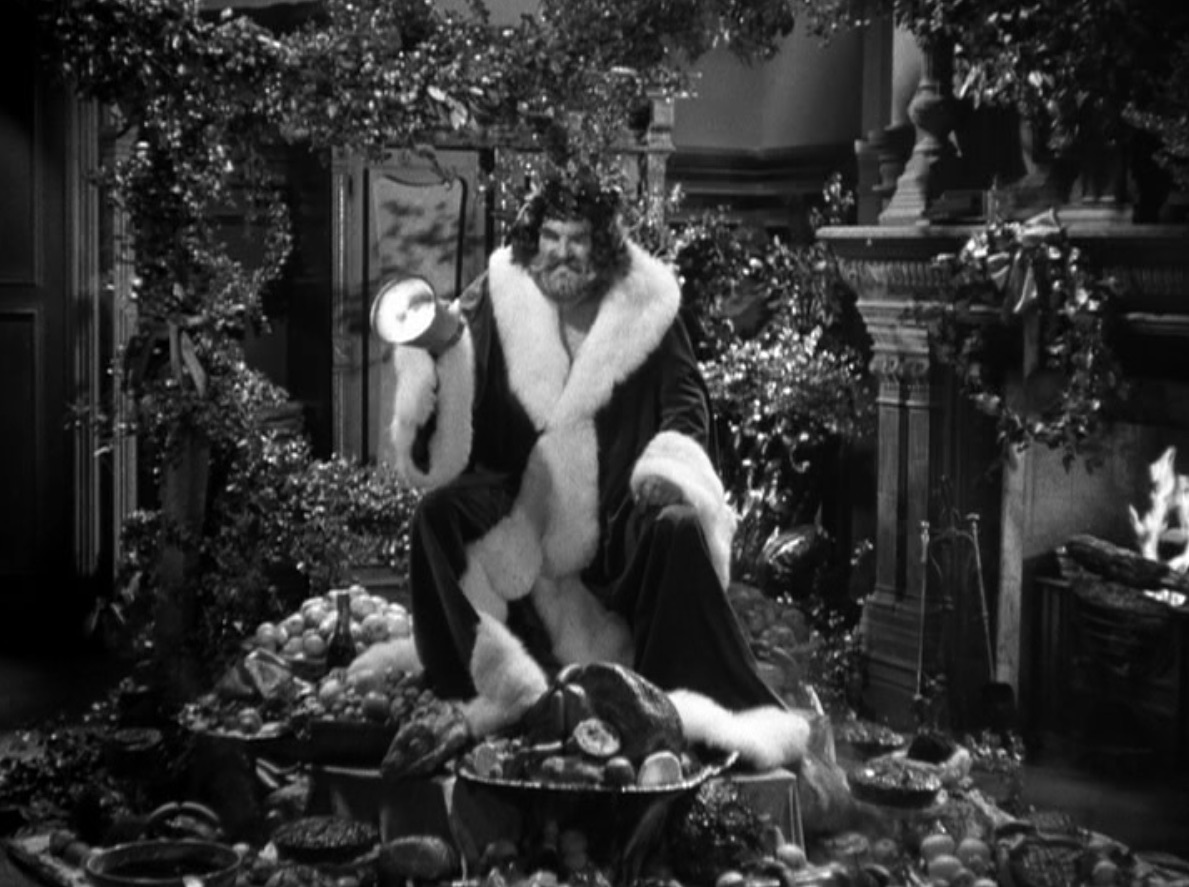
Almost as soon as the clock chimes, light begins pouring in around Scrooge's bed curtains, so he peeks through and sees our new Ghost. In this version, Scrooge's apartment is only the one room except for a little closet. The room is done up right though with a lovely fire, a wreath on the hearth, greenery all around, and the Ghost sitting on a chair surrounded by food. 

He looks great right away. I love his curly long hair and his bushy beard. His robe appears to be the right colors (as much as it can in black-and-white). He's waving around a horn-shaped torch, too. There's no visible flame from it, but it's giving off a strong light and a bit of smoke, so it works even though I prefer a strong, visible flame. His robe is open enough to see some of his bare chest and of course he has the holly crown (though without icicles).

He's not wearing a sheath and he's not giant-sized either even if he is quite tall. His robe is long enough to cover his feet in this scene, but later when he and Scrooge are walking around we can see that he's not barefoot. Even with those discrepancies though I like him a lot. He has a great, regal voice and he talks to Scrooge in a friendly way, but as if Scrooge is a child who has to have everything explained to him very simply. He's got a twinkly eyed Santa quality to him that's utterly charming.

In spite of Scrooge's rebellious regression at the end of Past's visit, he's back to being contrite and interested with Christmas Present. He doesn't say the line about having learned a lesson, but he's eager to see whatever this Ghost wants to show him. When the Ghost stands up, Scrooge asks with genial curiosity, "What are we going to do?"

"Walk into the world this Christmas night," the Ghost explains. "So that you can hear and see and feel Christmas."

Scrooge's response if funny. "Did you say walk or fly?"

The Ghost is amused and offers his robe for Scrooge to touch. And without knowing whether he's actually going to walk or is in for another scary flight, Scrooge does it. The room goes dark and there's some fog and then we're outside.

Tuesday, December 15, 2020

“Another Idol Has Displaced Me” | Reginald Owen (1938)

The 1938 Christmas Carol cuts Belle out of the story altogether. It also heavily modified the Fezziwig scene to eliminate the party while still showing Fezziwig's loving management of his employees. This version added some extra story at the beginning with Scrooge's nephew running into Bob Cratchit's kids and then having a visit with Bob, and eventually with Bob's getting fired for accidentally ruining Scrooge's hat with a snowball. We've apparently got to make that time up somewhere, so this is where the adaptation cuts a couple of corners. When the Ghost declares at the end of the Fezziwig scene that her time is running short, she's not kidding.

Scrooge was already cranky at the end of the Fezziwig conversation, regressing a little in the progress of his transformation and getting defensive about how he's a good business man. The Spirit loses patience with him about that and sums up the rest of what she was planning to show him: "I've yet to show you the black years of your life: your gradual enslavement to greed, your ruthlessness, your ingratitude, your wretched thirst for gold!"

Scrooge protests through all of this and shouts for her to leave him. He's been confronted - and I think convinced - that he needs to change, but this is a big step backward. The Ghost of Christmas Present in this version is going to have more work to do than his counterparts in other adaptations where Scrooge made more progress in the Past. 

This Spirit of Christmas Past hasn't carried an extinguisher cap, but Scrooge is so angry and desperate that he grabs her skirt and throws it over her head. It's super awkward, but thankfully the camera stays on Scrooge and we don't actually see the Ghost as she's assaulted. Scrooge simply yells that he can't stand any more as the scene dissolves from his clutching the Ghost's clothing to him in his bed trying to strangle his own bedsheets.

Tuesday, December 17, 2019

“Why, It’s Old Fezziwig!” | Reginald Owen (1938)


The 1938 Christmas Carol does something very different with this year's scene, but it's all in service to communicating the actual point of the scene well. Certainly better than the last couple of adaptations we looked at. There's been a trend of using Fezziwig's just to introduce Belle and identify the stakes involved when she and Scrooge break up. But the Reginald Owen film keeps the focus squarely on Fezziwig and his relationship with his employees.

After a standard, fade out/in transition from the schoolhouse to the streets of London, the camera lands on the warehouse of J Fezziwig and Company. Outside, the Ghost and Scrooge see Fezziwig working through a big window. His desk is normal sized, but he's a paunchy old gentleman with an outdated brown wig. Old Scrooge is thrilled to see him.

Fezziwig happens to look up at the clock and see the time, so he finishes up what he's doing and calls in Ebenezer and Dick. After faking like he's upset with them, he reveals that he's "angry" because they've let him work them 5 minutes past closing time. And on Christmas Eve at that. This Fezziwig isn't shutting up early for a party, but he does ask the boys to close up shop as they normally would. And part of that does involve going outside and putting up removable shutters as Dickens described it.

I wanted to pay especially close attention to Scrooge's relationship with Dick Wilkins in this version, because the previous scene revealed that they were also schoolmates and good friends as children. There's nothing in the dialogue this scene to suggest a special attachment between the two, but as they shut up the windows the boys clearly enjoy each other and have a fun, bubbly conversation about how awesome Fezziwig is.

This underlines something I've been thinking about over the last couple of adaptations. I expressed earlier that I felt there might be a story behind Scrooge's recognition of Dick's attachment to him and his suggestion that he pitied Dick for some reason. I wondered if something bad happened to Dick that made Scrooge regret not treating him better. In Owen's version, the friendship is clearly mutual (no "poor Dick" here). So contrasting that with the other versions, I wonder if Scrooge's lack of attachment to Dick in those versions wasn't so much specifically about Dick as it was just about Scrooge's not being able to connect with people in general. Maybe his childhood experiences in school and with his father just made him withdraw. So "poor Dick" isn't necessarily about something specific that happened to Dick, but just symbolic of Scrooge's general remorse for not being able to connect to people at all. That's not the case in this version, but Scrooge's friendly relationship with Dick here helps make more clear what I think I've noticed in the others.

Since Fezziwig isn't throwing a party after work, his conversation with the boys goes a different direction. It's pretty much the opposite of Scrooge's earlier conversation when he closed up with Bob Cratchit. Like before, Fezziwig pretends to be serious as he says, "Now about tomorrow..."

The boys get very serious, too.

He wags a finger at them. "It's a holiday of course, but I shall expect you to spend part of it at least with me." He pauses for a beat to let them sweat. "Eating Christmas dinner!" They're overjoyed. We know that at least Scrooge's family lives in the countryside and the same may be true of Dick's. And Fezziwig says that if they eat too much to be any good the following day, "We'll make that a holiday, too."

I love this Fezziwig's sense of humor. It's a missed opportunity that Owen's Scrooge doesn't wait until after Christmas to reveal his change to Cratchit, because that scene (as Dickens wrote it) would suggest that Scrooge picked up his warped humor (pretending to be angry and then announcing that he isn't) from Fezziwig. But since this version had Scrooge fire Cratchit on Christmas Eve, Cratchit won't be going in to work at all on the 26th.

Fezziwig also tips the boys a gold sovereign each as a Christmas bonus before leaving, sparking the apprentices to praise him some more.

Outside, Old Scrooge is thoughtful, but he denies at first that anything particular is wrong when the Ghost questions him about it. She pulls out of him that experiencing Fezziwig's kindness again has bothered him, but that's all he's willing to offer. She points out gently, but bluntly that "perhaps you feel that you'd like to repay his kindness to you."

This makes Scrooge grumpy. "Well?"

"You have a clerk, Bob Cratchit. Old Fezziwig would have been very happy if you had shown your gratitude to him by showing kindness to others."

Scrooge is now very defensive, fussing about how he's a good business man. Apparently he's temporarily forgotten his earlier conversation with Marley about what constitutes "good business."

This is a sad, but realistic regression in Scrooge. I thought before that he was going to have an easy transformation. The early scenes showed him to be a lonely man who seems to be interested in human connection, but doesn't know how to appropriately ask for it. I noted that he may even think that he's putting signals out, but his abrasiveness keeps people away. I think that's what's going on here. Scrooge is thoughtful and wants to change, but he's got a lifetime of defenses that aren't going to be dismantled easily. That's probably why this Ghost doesn't rhetorically criticize Fezziwig in order to bait Scrooge into defending him. That tactic probably wouldn't work on this Scrooge.

There's a little more dialogue in this scene, but I'll save it for next year. Not only is Fezziwig's party absent, but the entire character of Belle is, too. Instead, the Ghost will crankily and impatiently sum up Scrooge's subsequent years for him.

Monday, December 17, 2018

“I Was a Boy Here!” | Reginald Owen (1938)


The 1938 Christmas Carol has the Spirit leading Scrooge out of his window and in a flight, first over the city of London, but that fades and becomes a snowy country scene. (I don't know how this section was shot, but I assume the filmmakers created miniatures and they are amazing.) Scrooge is already smiling while still in the air. He's got no fear of falling at this point and seems to be enjoying himself. I don't know if he recognizes the specific places yet, but it may be bringing back childhood memories already.

They hone in on a particular building: a large mansion surrounded by a walled estate. The camera lowers as it slowly zooms in, indicating that Scrooge and Spirit are landing here. There's a clever fade from the miniature to the front gates of a location shot where the camera is still lowering from a high angle to ground level. Through the gate, we see a crowd gathered around a large carriage. There's a lot of pleasant conversation as people direct the loading of their things and make their goodbyes to each other.

Another fade and we're looking at Scrooge and the Spirit standing near the wall. This is where Scrooge exclaims that he recognizes the place, but he doesn't say that he was bred here. He just says that it's his old school. By tweaking the line, the film has already made a statement about Scrooge's experience. In Dickens, the area of the country is a source of joy for Scrooge, while the school is a symbol of loneliness for him. Now, the school is a joyful memory, as Owen clearly indicates through his acting. He's smiling and leads the Spirit through the gate and into the yard for a closer look.

The full carriage pulls away from the school with lots of shouting, waving boys aboard. As it leaves, another pulls up for the next load of kids. Scrooge waves at the first carriage, recognizing several of the students on it. These are his friends and he has good feelings about them. He calls out a bunch of names (Harry, Joe, Tommy, and Percy) before getting to one that I recognize: Dick Wilkins (Scrooge includes the last name as he calls, extra excited by seeing his particular kid). If I'm not misremembering, Dick is Scrooge's fellow apprentice at Fezziwig's, but this version has him and Scrooge also being classmates. I like that. School was generally a happy place for this Scrooge and the place where he formed one of his longest lasting friendships.

Scrooge is deeply affected by being here and the Spirit notices that he's trembling. He blames it on the cold, as he also does later when she notices something on his cheek (which is good, because in Dickens, Scrooge tries to claim that the thing on his cheek is a pimple instead of a tear and that's super lame). I really enjoy their interactions in this version. Scrooge has a huge smile on his face and is enjoying this, only sobering when the Spirit tosses straight-faced zingers at him to make him think. She sets him up ("You remember this way?"), lets him respond enthusiastically ("Remember it? I could walk it blindfold!"), then sweetly nails him ("Strange to have forgotten it for so many years") before leading the way herself. Maybe I'm just in love with Ann Rutherford, but the way she plays Scrooge and his emotions is beautiful to watch. It doesn't appear to bother Scrooge, either. She's so gentle about it that he's smiling even after she's stung him.

Owen's Scrooge is going to be an easy transformation, I think. The early scenes showed him to be a lonely man who seems to be interested in human connection, but doesn't know how to appropriately ask for it. He may even think that he's putting signals out, but his abrasiveness keeps people away. The Ghost is showing him a time when he had that connection and it's rebooting his system. If he can remember how he used to relate to people before he erected some of the barriers he's currently got in place, he can be saved.

The Spirit leads Scrooge to the front door of the school where Scrooge recognizes his younger self saying goodbye to a boy named Jack. Young Scrooge is in his early teens, because this version is combining Dickens' two visions at school into one. That means that we lose the Ali Baba and Robinson Crusoe references, but I don't miss them. This version is making a different point and it sticks to it marvelously well.

Scrooge and Jack are friendly with each and Jack asks if Scrooge's parents are coming for him. Scrooge explains that he's staying at school (and that he always does), but describes it as a mutual decision reached by him and his father. He's not very convincing about it though and Jack criticizes Scrooge's dad. Surprisingly, Scrooge defends the old man and gets a little huffy. Jack apologizes and then has to leave because he's being called to the carriage. Once he's aboard, he and the other departing students wave goodbye to Scrooge and wish him Merry Christmas.

So in this version, Young Scrooge isn't neglected by his friends at all. They seem to like him and his only problem is that his father doesn't seem to want him around, which stings especially hard this time of year. Scrooge gives a sad wave to his classmates, then walks dejectedly back into the building. He wanders into a classroom where he looks out the window and breaks down into tears. The score is lovely in this version and grows especially beautiful and heart-wrenching during this scene.

The classroom looks nice and not at all rundown. This may or may not suggest anything about the finances of Scrooge's dad. The point seems to be just that this is generally a happy place for Scrooge, though no substitute for family. He wants to be home and is heartbroken that he's not welcome there.

He's already composed himself though by the time the schoolmaster appears. This isn't a sad, pathetic character like in Dickens, but a jolly-looking man with a kindly voice who announces that Scrooge's sister has come to see him.

Fan is younger than Scrooge; about nine years old. And the little actor who plays her (Ira Stevens) is wonderfully accurate to Scrooge's description. She's bubbly and joyful about bringing Scrooge home; almost annoyingly so, but Scrooge is so delighted to see her and to hear her message that it's impossible to be irritated. She's young, so she's focused on Scrooge's coming home for Christmas, but she does throw in the line about his going to work after the holiday and not returning to school. That sounds like a kindness in Dickens, but I can't help but think that this Scrooge may not see it that way. He looks understandably confused by Fan's announcement. There's a lot for him to process in there.

I don't know if Scrooge ever got any answers about why his father has changed his plans for Scrooge. The film doesn't suggest any and the point of the scene is that Scrooge more or less had a decent childhood except for the lack of this one, very important relationship with his dad.

As Young Scrooge leaves the room with Fan, Old Scrooge and the Spirit talk about Fan's love for Scrooge and the Spirit brings up her "children."

"One child," Scrooge corrects, absent-mindedly because he's still thinking about his sister.

"Your nephew, Fred," the Spirit pokes. Scrooge looks at her, getting what she's saying and doubtlessly remembering his last interaction with his awesomely jovial relative. Her point made, the Spirit sweetly, almost shyly invites Scrooge to come with her to the next scene.

Monday, December 18, 2017

“Your Reclamation, Then” | Reginald Owen (1938)


Index of other entries in The Christmas Carol Project

The 1938 Christmas Carol jumps straight from Scrooge's hopping in bed to almost 1:00. Something wakes him up a few seconds early and he checks his pocket watch. He must decide that it's close enough to the appointed time, because he gets cocky, thinking that either Marley was wrong or that maybe he, Scrooge, dreamed the whole thing. But as soon as he says, "Humbug," the clock chimes one and the bed curtains pull themselves back.

I wouldn't call Scrooge frightened at this point, but he's startled by the appearance of a glowing figure that gradually solidifies into the Ghost (as she calls herself) of Christmas Past. Director Edwin L Marin has taken some big liberties with his version, but I'm not going to complain. Ann Rutherford (from the Andy Hardy movies) plays the Ghost and she's absolutely gorgeous.

In addition to being very young and very female, she doesn't carry a cap or holly. And after the initial glow effect of her appearing in Scrooge's room, she's not particularly shiny. She does wear all white though with some sparkles. And her face and hair are fair. So she does stand out in contrast to the dark room and that must be what Scrooge refers to when he complains that the light hurts his eyes. "It blinds me," he adds, being a little over-dramatic.

She doesn't have a snuffer cap to put on (in fact, she's already wearing a snazzy hat with a glittery star on it), so Scrooge doesn't offer a suggestion for what he wants her to do about the light. Which means that her reply is less huffy than the Spirit in Dickens' version. She simply says that she's not surprised that the light bothers him. "It's the warming light of thankfulness. The light of gratitude to others."

That's a different interpretation than the one I came up with. Dickens is vague about what the light represents, but I've always thought of it as the illumination that comes from self-reflection and remembering the past. Making it specifically about appreciation feels out of nowhere, but it could work if that's a theme that the Ghost repeats throughout the scenes that she shows Scrooge. Something to keep an eye on.

In a surprising display of self-awareness, Scrooge admits that he's never seen this light before. Although I believe that his comment is actually a complaint that no one has ever shown him any gratitude. Reginald Owen's Scrooge is a lonely man who seems to be interested in human connection, but doesn't know how to appropriately ask for it. He may think that he's putting signals out there - his snide comment that Cratchit might make something of himself if he worked overtime comes to mind - but his abrasiveness keeps people away. And in this moment, I'm sensing that he resents it.

The Ghost turns Scrooge's comment around on him, though. She's says that of course he's never seen gratitude, because his greed has caused him to forget it. In other words, he doesn't care enough about people to show them any gratitude, so why should he expect better from them?

This makes Scrooge think. "Oh," he says. And it seems to me that Scrooge is being shockingly gentle with the Ghost. He's still abrupt and cranky, but he seems willing to listen to her. And she doesn't appear willing to take any crap from him either. She reminds me of my wife, actually. I've known some notoriously miserable people who emotionally bully others and just get meaner the more that their victims back down. But Diane won't take it from them. She pushes right back and these people respect and like her for it. That's what I sense is going on between Scrooge and this ghost.

He asks what her business is with him and she declares, "Your welfare," before immediately adding, "Your reclamation." There's no hint that he's making jokes to himself about unbroken rest; she's just clarifying what kind of welfare she's talking about. Perhaps so that he doesn't think that she's referring to financial benefit.

She orders him to rise and walk with her and he obeys. He looks curious more than anything else. As if he's trying to figure out who this woman is and why she's affecting him the way that she does.

She leads him to the window, which opens by itself, and steps up onto the sill. Scrooge looks a little worried and makes a motion with his hand. He could be asking for help up onto the sill or he could be indicating the outside and the long drop to the street. He doesn't actually need help climbing up though, so it's probably the latter. And once he's up there, he looks around silently, clearly confused about what's going to happen next.

Her response to him feels a little oblivious. "We spirits have no fear."

So he says what I'm thinking, "But I'm not a spirit."

This is where she asks him to "bear but the touch of my hand on your heart," but instead of telling him that he'll be uplifted, she simply says, "And you shall be safe." I'm disappointed that she loses the double-meaning of Dickens' line.

He does bear her touch on his chest though, and he even places his own hand over hers. And they float out the window and into the air.

Thursday, December 15, 2016

“More of Gravy than of Grave” | Reginald Owen (1938)


Index of other entries in The Christmas Carol Project

The 1938 Christmas Carol continues to make some interesting changes to the story with this scene. For one thing, Marley's face doesn't appear on the knocker right away. Scrooge has already opened the door, lit his candle, and is turning to close the door again when Marley shows up (superimposed over the already demonic-looking knocker). I have a theory about why Marley might delay his appearance, but I'll get to that in a minute.

The face fades as quickly as it showed up, but Scrooge is visibly shaken. He recovers quickly though and heads up the grand, old staircase. It's pretty wide, but there's no hearse. Instead, the set design has cobwebs everywhere, giving the place a haunted house look. It's doubtful that any businesses are leasing offices in this place. Scrooge appears to be the only tenant and he's not exactly keeping up the place.

He's a little unnerved, but not exactly cowering in fear. Some spooky music accompanies him as he walks and it cuts out every now and then for him to stop and look around. It's as if he notices the music and it's messing with him by shutting up whenever he tries to pinpoint its source, then starting again when he resumes his walk.

In his rooms, he checks around, but with an attitude of actually trying to catch an intruder. He's not scared, he's irritated. When he locks the door, he's scowling and doing it more forcefully than he needs to, as if he's saying, "There! Try to get through that!"

He stokes his fire a little (apparently its been burning all day, but barely) and grabs a bottle from the mantle. Since this Scrooge already ate dinner at the tavern, the movie doesn't confuse viewers with an extra bowl of gruel. Dickens explained that the gruel was for Scrooge's cold anyway, so this movie substitutes a bottle of medicine. Or maybe "medicine." Earlier, Cratchit made a joke to Scrooge's nephew about Scrooge's "cough medicine" that seemed to imply that that's how Scrooge referred to liquor. Or maybe it really was medicine, but Scrooge - too cheap to buy real alcohol - used it as a substitute. Whatever the case, we see it in action here. Scrooge pours himself a spoonful, takes it, then licks his fingers where some spilled onto them. He's not missing a drop.

That done, he continues checking out the room. The bed is in here, but he goes through another door to get dressed. While he's out, a bell rope begins swinging back and forth, sounding the bell that it's attached to. Scrooge pokes his head back into the room (he's wearing a nightcap now) and the rope immediately stops. Someone's messing with Scrooge. He whispers, "Humbug," and closes the door again, which signals the rope to start moving and clanging again. The next time Scrooge comes out (in his robe this time), the bells in the house go nuts.

Scrooge's attitude during all this is more "what the hell's going on?" than fear. He's trying to figure this out, but he doesn't look worried. The bells stop, there's an immediate slamming of a door somewhere, and then Marley appears. He's transparent and wearing the bandage, but there's no sign of his personal atmosphere blowing his hair or anything.

Scrooge is a little taken aback when Marley confirms who he is, but Scrooge quickly recovers and the conversation takes a very unusual tone. In Seymour Hicks' version, I got the feeling that Marley was the stronger of the two partners. Scrooge not only deferred to him during their talk, he also seemed upset when Marley left. Reginald Owen's Scrooge is the opposite of that. He fusses at Marley the way he fussed at Cratchit earlier, giving the impression that it was Scrooge who dominated the relationship when Marley was alive. This makes me wonder if Marley's delayed appearance at the door may have been evidence that Marley himself is a little afraid of Scrooge. Or at least not super eager to have this conversation with him. He could be doing it out of compassion (or penance, if we're less charitable towards him), but still not look forward to it.

Scrooge talks about Marley's possibly being a digestive issue, but there's no humor in it. He doesn't even use the gravy pun. Marley's answering moan is pitiful, not threatening, and Scrooge orders the ghost to be quiet.

At this point, the film adds something completely new to the scene. Scrooge hears the night watch in the street below, so he goes to the window to call them up. They come to his room to investigate, but of course Marley has disappeared. After the watchmen make some jokes about Scrooge and spirits ("of one kind or another"), they leave and Marley returns. The effect of the incident is to break whatever spell Scrooge thought he might be under. Somehow, having Marley still there after the sobering conversation with the watchmen makes Scrooge realize that he's not hallucinating.

Scrooge concedes that he must believe in Marley, but he's still not afraid. He's just as grumpy and demanding as before. To be fair, Marley doesn't appear to be afraid of Scrooge either. He's confident in his mission and he forges ahead, but it's so odd to see Scrooge stand up to him. As they continue talking, Scrooge begins to soften towards his old partner some, perhaps taking some comfort in the renewed relationship. This version of Scrooge has already showed signs of wanting some human connection. He seems to hear what Marley is saying about the future and the need for Scrooge to change. But unlike the other versions, it's Marley's words that are having the biggest impact, not the way that he's delivering them. It's like he's confirming something that Scrooge has already known or suspected about himself.

Scrooge never drops his wall though. He dismisses Marley and his chance at redemption. At least until Marley mentions the three spirits that are coming. That unnerves Scrooge a little and he asks Marley to stay, presumably to explain further. Marley's already heading for the window, but he reveals that the spirits will all come that evening: one an hour between 1:00 and 3:00 am. He even repeats the schedule, accompanied by bells chiming the times as he says them. And then, standing by the open window, he disappears.

This version cuts out the phantoms in the street. Scrooge is nervous now, mopping his forehead with his handkerchief and quickly closing the window. He doesn't even try for half a "Humbug," but jumps in bed and pulls the curtains. He could deal with Marley okay, but he's not at all excited to see what's coming next.

Friday, December 18, 2015

His Usual Melancholy Tavern | Reginald Owen (1938)


Index of other entries in The Christmas Carol Project

Like I mentioned last year, the 1938 Christmas Carol follows Bob Cratchit outside, but it's not to watch him slide with the boys. Instead, he gets caught up in a snowball fight and soon begins teaching the lads his technique for a perfect snowball. The kids' lookout lets them know that there's a fellow coming with a top hat, so Cratchit sees an opportunity to continue the boys' education in proper throwing. Unfortunately, he lets fly and knocks the man's hat off before realizing that it's Scrooge himself. Apparently the boss didn't stick around too long at the office.

Scrooge looks positively shocked that Cratchit would behave this way. I've always read that as simple indignation, but after measuring up Scrooge last year, I now either detect or imagine some actual hurt in his expression. My working theory is that Owen's Scrooge sort of sees some promise in Cratchit, but is constantly disappointed by the man's choices. This insult is one step too far and - in a shocking move for those familiar with the story - Scrooge fires Cratchit right there. I used to think he's just being mean, but now I believe Scrooge is acting out of distress. He feels betrayed and responds in his typically nasty way.

The movie continues to follow Cratchit, who's despondent at first, but quickly recovers his Christmas cheer. He's just been paid (minus what Scrooge charged him for the ruined top hat) and it's fun to watch him go on a Christmas shopping spree, collecting the food for tomorrow's feast. Over and over again he announces to a vendor that he's willing to spend x amount, but then increases it in keeping with the celebration. I don't know if he blows his whole payday, but he doesn't seem to care if he does. He's determined that whatever happens on December 26th, this is going to be an awesome Christmas.

This version follows Cratchit all the way home and we get to meet his family earlier than in most adaptations. (Of course, we've already met Peter and Tiny Tim in the first scene.) He doesn't tell anyone that he was sacked; he's intent on their enjoying the holiday without letting Scrooge ruin it.

The film then dissolves into Scrooge's lonely dinner at the tavern where he's reading a banker's book. Like in the Seymour Hicks version, this one communicates melancholy by having Scrooge be the only patron in the place. Curiously, he leaves the banker's book on the table when he leaves, as if it belongs to the tavern. Maybe I misunderstood what a banker's book is (my annotated Christmas Carol and Google don't elaborate) or maybe it's a mistake of the movie, but it's interesting to think of it as possibly not Scrooge's own accounting records, but some sort of publication circulated by the finance industry. Perhaps Scrooge doesn't own a copy himself, but comes to this tavern to read theirs. It's a weird theory and doesn't seem likely, but it's the best I have.

After dinner, Scrooge makes his way home. The streets aren't as empty as in some of the other versions we've looked at so far, but they're lonelier near Scrooge's house. This version has the big gate, but a small yard. Still, the large, old house looks plenty withdrawn and desolate.

Wednesday, December 17, 2014

“If Quite Convenient, Sir" | Reginald Owen (1938)


Index of other entries in The Christmas Carol Project

Reginald Owen's Scrooge is a fascinating man, and not just because of that weird tuft of hair. He was consistently rude to the charitable solicitors, but in his conversation with Fred he showed some glimpses of humanity. There were parts of that scene where the conversation was pretty much over, but he re-engaged and kept it going. His dislike of Fred seems more like a defense mechanism than an honest reaction.

There's a little of that going on with Cratchit, too. Gene Lockhart is a funny actor and we get some great moments from his Cratchit. After the solicitors leave and Scrooge shuffles back into his office (Scrooge's walk is another interesting thing about him; Owen makes it look like he's in some kind of chronic pain that affects his posture), Cratchit looks at the clock and then listens to it to make sure it's ticking. He sighs heavily and then has some of the port that Fred left on his desk earlier. He's absolutely miserable, partly because of whom he works for, but also because it's Christmas Eve and those last fifteen minutes are gonna draaaag.

There's a dissolve and Cratchit is still watching the clock, but it's 6:30 now; forty-five minutes since the last time we saw him look. Scrooge comes out and catches him, leading to some great dialogue that's not in Dickens. "You keep close watch on the closing hour!" Scrooge observes.

"It's half-an-hour past," says Cratchit. I can't tell if he's supposed to close at 6:30 or if he was supposed to be done at 6:00, but either way he seems to have been waiting for Scrooge to come out and give the okay to go. Owen's Scrooge has a tight rein on his clerk.

"Then close up! Close up!" barks Scrooge. "Don't work overtime, you might make something of yourself!" It's one of my favorite lines in any adaptation. It's such a grouchy old man thing to say, but it also suggests the slightest possibility that Scrooge sees potential in Cratchit and is angry that Cratchit would rather get home and celebrate Christmas.

Based on some things that happen later, Owen's Scrooge feels profoundly lonely to me. It's his own doing, but I feel bad for him, especially when he keeps dropping hints that he'd like for someone to tear through his wall. That also adds a different dimension to his complaining about Cratchit's taking Christmas off. Not only does Scrooge have to pay Cratchit for no work; he's also going to be stuck at home by himself all day.

There's another added bit that's not in Dickens when Cratchit timidly mentions that it's payday. Scrooge is pretty unfair, but funny when he grouses, "Can't wait to spend 'em, eh?" But he pays up and sends Cratchit on his way, staying behind to close up.

This isn't the only version where Cratchit leaves ahead of Scrooge, but the others make it seem like a trust issue. Owen's Scrooge seems to sort of like Cratchit in a weird way, so that's not the case here. It's more of a work ethic thing. Cratchit can't wait to get started on Christmas while Scrooge hangs back to get some more work done (though he appropriates the bottle of port from Cratchit's desk to keep him company).

The movie follows Cratchit into the street, but he doesn't join the boys in sliding. We've already had a sliding scene earlier with Fred and Cratchit's sons (and will get another with Fred later), so Cratchit engages in a snowball fight instead. That becomes a significant part of next year's scene though, so I'll leave it until then to talk about.


Wednesday, December 04, 2013

'You Wish to Be Anonymous?' | Reginald Owen (1938)


Scrooge's nephew, still maintaining his Christmas spirit after an unpleasant conversation with his uncle, wishes a Merry Christmas to two, incoming gentlemen as he leaves. Thanks to the set up of Scrooge's office in this version (with Scrooge having a separate room and Cratchit's occupying the foyer), the gentlemen greet Cratchit first and there's a lightly humorous moment as they mistake him first for Marley and then for Scrooge.

Scrooge comes out during this though and quickly corrects them. He doesn't know what they're here for yet, but he's already in a bad mood, possibly because of his encounter with Fred, but of course we get the feeling that he's sort of always that way. This is no way to address potential customers, but this Scrooge is so miserable that he doesn't care.

This version actually gives names to the two gentlemen: Twill and Rummidge. Further humanizing them, the script also allows them to share the conversation instead of following Dickens' lead and just having one of them interact with Scrooge.

We learn about Marley's death for the first time in this version when Scrooge explains it to the men, and the detail that it was seven years ago. That's just following Dickens, but it works just fine as exposition too, though we don't get a sense yet of the kind of man Marley was. Of course, that will become very clear later when we meet his ghost.

There's a nice reaction shot of Cratchit as he nods at Rummidge's explanation of the reason for their visit. Charles Coleman and Matthew Boulton are well cast as the gentlemen. They have a clean, pleasant look to them and both men communicate gentle kindness and compassion for the people they're trying to help. The music makes it an overly sentimental scene, but it's genuinely touching acting by Coleman, Boulton, and Gene Lockhart as Cratchit.

Scrooge on the other hand is just mean. This interaction has none of the brief glimpses of regret in Scrooge that we saw in his conversation with Fred. He's got no time for these guys and wants them out as quickly as possible.

They seem to get that he's not with them, but still hopefully offer him the line about being anonymous when he says he to put him down for nothing. They've given some disturbed looks prior to that in the conversation, but even then they don't quite believe that he's as mean and cold as he seems to be. They can't seem to imagine it until he offers the final line about decreasing the surplus population. At that point they look very concerned; about Scrooge as much as about anything else, which further illustrates their sincerity and compassion. They're really a wonderful pair and are going to be the ones to beat as my favorite portrayal of these characters.


Thursday, November 29, 2012

'Merry Christmas, Uncle!' | Reginald Owen (1938)


In Reginald Owen's Christmas Carol, the story opened not with Scrooge in his counting-house, but with his nephew's meeting a couple of Bob Cratchit's kids on the street. We got to see how good-natured Fred is and - through his conversation with Peter and Tiny Tim - learned a little about what people think of his Uncle Scrooge.

After leaving the boys, Fred continues his walk towards Scrooge's office, grinning at shoppers and cheerfully brushing snow from his coat after being knocked into a snowdrift in the last scene. He soon arrives at the building with the Scrooge & Marley sign and it's humanizing to see him pause to look up at the sign and collect himself. He looks worried for a second, but then visibly shakes it off, smiles sadly, and goes inside.

He doesn't burst in and force his cheerfulness on the place. He opens the door and Cratchit - who's sitting right there - doesn't even look up. He sort of half-acknowledges that someone's just come in, but doesn't turn to see who it is. When Fred calls him on it and asks, "Aren't you going to wish me a Merry Christmas?" Cratchit looks stressed, but tears himself away from his work to greet his visitor. He quickly explains that he thought it was Scrooge coming in, implying that he was trying to look busy.

A quick word about Gene Lockhart, who plays Cratchit in this version. Not a thin man. I like his performance quite a bit - his Cratchit is persecuted, but refuses to lose his Christmas spirit - but it kind of goes against the idea that he's so poor when he looks so well-fed.

Fred and Cratchit exchange Christmas greetings and Fred explains that he's already seen Peter and Tim. He passes along the grocery list that they asked him to deliver to Cratchit, which embarrasses the clerk a little, but Fred says that he was pleased to do it.

Fred notices how cold it is in the room and wonders about the small fire. I like that there is actually a small fire in Cratchit's room. It's obviously not big enough to warm the area, but it's not so small as to be humorous. Fred says that he foresaw the need for warmth at Scrooge's and provided for it. Eyes sparkling, he produces a bottle of port from his coat pocket. You can probably tell that Barry MacKay is my favorite Fred. He remains consistently cheerful and charming throughout his performance without ever becoming obnoxious with it. I want to celebrate Christmas with his Fred.

When he and Cratchit realize that they don't have a cup to drink from, Cratchit is emboldened to go get one from Scrooge's office. Fred sniffs it when Cratchit hands it to him and turns up his nose. "What is this?" he asks.

"Cough medicine," replies Cratchit.

Fred laughs, but you can tell he's a little disgusted as he cleans out the glass with his handkerchief. "I thought so."

The merriment makes Cratchit even more brave and he declares that they will have some more coal for the fire. Egged on by Fred, he goes back into Scrooge's office and emerges with a heaping shovel full of coal that he throws onto the fire.

Providing fodder for all those Christmas Carol slash writers, Fred declares, "Come on now, Bob! Let's drink a loving cup! You sweeten it!"

Cratchit takes the cup and has it to his lips when ominous music sets in and the door opens to reveal Reginald Owen as Ebenezer Scrooge. He stands still for a moment, taking in the scene with no expression.

As Scrooge silently closes the door, Fred puts the wine bottle on Cratchit's desk with a bemused look on his face that says, "Oh crap. We've been caught." Cratchit, of course, is considerably more worried. As Fred reaches to shake hands with his uncle and wish him a Merry Christmas, Cratchit sets down the glass and hurries to the fire to pick out as much unburnt coal as he can with his poor hands. Scrooge, calling Christmas a humbug, walks into his office, casually noticing what Cratchit's doing as he passes.

Fred follows Scrooge into the office and the conversation continues. Scrooge takes off his hat and coat, revealing a ridiculous tuft of hair on top of his bald head. I've always assumed this a bad bald wig, but it does make Owen's otherwise powerful Scrooge rather pitiable, so maybe it's intentional.

The conversation goes more or less as Dickens wrote it, with Scrooge's continuing to settle into his office throughout. I love the staging here. It's not just Scrooge and Fred talking to each other over a desk. They're both moving around the room the whole time, giving the scene energy that it doesn't usually have in other versions. I wonder if that'll continue throughout the movie.

When Scrooge says that he'd like to bury Christmas celebrants with a stake of holly through their hearts, he means it. Owen's Scrooge shows none of the subliminal humanity that Seymour Hicks gave his version. At least, not at this stage.

Fred - for once - is shocked by Scrooge. "Uncle!"

Scrooge looks pissed. "Nephew!" He'd physically remove Fred from the building if he was strong enough. Since he's not, he orders Fred to let him keep Christmas in his own way.

That softens Fred a little as he says, "But you don't keep it."

Scrooge turns his back on his nephew. "Let me leave it alone then."

The conversation seems to be over, but as an afterthought, Scrooge looks back at Fred and says, "Much good it has ever done you." In the novel, this flows naturally out of Scrooge's last comment, but the way it's done here, Scrooge has suddenly re-engaged with the discussion. We're not sure why. Probably, he's still angry and is just being mean. There's something in his eyes though - and maybe I'm reading too much into it or seeing softness that isn't really there - that makes me wonder if he's not challenging Fred to convince him.

If so, Fred rises to the challenge. His "It has done me good" speech isn't word-for-word what Dickens wrote, but it captures the spirit well enough, assisted by sentimental, heavenly background music. MacKay's delivery of the speech is skillful. It's gentle and warm; never cloying or cheesy. Scrooge really does visibly soften during this. He keeps trying to turn away, but can't. And while he's drawn in to Fred's speech, he can't maintain eye contact the whole time. This is a Scrooge who's bitterly angry about the world, but searching - deep, deep down - for a reason to engage with it.

We also get a shot of Cratchit, listening gratefully from the other room and being emotionally stirred. By the end of the speech, he's clapping enthusiastically. Like in the novel, he suddenly realizes what he's doing and rushes from his chair to go poke the fire. He doesn't extinguish it the process - probably because it's still got some of that extra coal on it - but it's still quite funny thanks to Lockhart's comedic ability.

Scrooge, already looking for a way to escape Fred's speech, comes into Cratchit's room and threatens his job. Cratchit seems genuinely concerned about the threat (this is the first he's received in this version) and can't get back to his desk quickly enough.

The mood of the speech broken, Scrooge returns to his office and compliments Fred on the power of his speaking. He's not looking at Fred though; he seems to want to dismiss him quickly. Fred realizes this and comes to the reason for his visit, introducing his wife's name in the process. "Come and dine with Bess and me tomorrow."

Scrooge doesn't seem to know who Bess is, so Fred clarifies that she's his fiancé. He also reveals that he's dining with "her people," but that he's sure they'd welcome a visit from Scrooge as well.

Scrooge expresses surprise that Fred's engaged, so we skip the whole "I'll see you in Hell" part. Instead, the conversation goes immediately to why Fred's getting married. Fred's being engaged instead of already married is a significant change from Dickens' text. As is Scrooge's ignorance about the relationship. It eliminates that as a reason for Scrooge to be angry at Fred. In fact, Fred would please the literary Scrooge when he says that Bess and he are waiting to be married until after Fred can afford to support her.

Another change is that Scrooge hasn't yet declined the invitation, having been sidetracked by Fred's news. Nor is there any indication that this is an annual request. The implication is that Fred's inviting Scrooge because he's recently engaged and wants the families to meet.

Scrooge suspects other motives though and accuses Fred of wanting money so that he can get married. Fred laughs and says that wasn't it, but Scrooge doesn't believe him. "Good afternoon," he says, picking up Dickens' version of the conversation.

We don't know what Scrooge and Fred's previous relationship was. We can be sure that they've never been friends, but there's no indication that Scrooge holds him any special ill will. All we can tell is that Scrooge resents his nephew's holiday spirit and now thinks he's after Scrooge's money. (Though it's possible that he's pretending to be suspicious because he's afraid to connect, especially after Fred's speech.)

Fred - refusing to lose his cool - laughs heartily and tries to part on friendly terms, but Scrooge keeps good-afternooning him until he gives up and leaves, pausing to exchange some last, warm wishes with Cratchit. On his way out, he has the opportunity to wish a Merry Christmas to two other gentlemen who are just coming in.
Tuesday, December 06, 2011

Old Sinner: Reginald Owen (1938)


The Reginald Owen version of A Christmas Carol sets the stage with a title card (“More Than a Century Ago…in London…on Christmas Eve.”) over the London cityscape (including Saint Paul's, of course) accompanied by a men's choir singing "Hark, the Herald Angels Sing." It follows this with various scenes of Victorian people enjoying their Christmas. It's one of my favorite openings.

Whereas the 1935 version is immediately gloomy, I love that this one - rather than go right to wretched, old Scrooge’s place - provides contrast first by showing people having a good time and reveling in the holiday. We see shoppers and vendors and kids sliding on ice. (Pretty much every version of A Christmas Carol has an ice-sliding scene. I think I remember Dickens’ mentioning the sport briefly in the book, but it’s kind of amazing that so many film-makers included it in their versions.)

Into this scene walks a cheerful, young gentleman who joins the children in their sliding. He’s cheered on by a lame boy who’s watching the fun from the sidelines. The boy of course is Tiny Tim and he’s there with his older brother Peter. The gentleman puts Tim on his back for a slide, but gets accidentally bowled over by Peter in the process. Rather than getting angry about it, the gentleman good-naturedly announces that his only regret is that Peter broke his sliding record.

The gentleman learns that the boys are waiting for their father, Bob Cratchit, the clerk who works for Mister Scrooge. When he says that he’s on his way to see Scrooge himself, the boys ask if he’ll deliver a message to their dad. The gentleman asks why they don’t want to see their dad and they reply that it’s not him, but Scrooge they’re afraid of. He’s “not fond of small boys.” That’s when the gentleman reveals that he knows that all too well. He’s Scrooge’s nephew Fred and he experienced the old man’s wrath first-hand as a child himself. Embarrassed and afraid, Peter and Tim flee, but Fred grins and winks after them.

Like I said, I love the uniqueness of this opening. Without meeting Scrooge at all, we get a feel for who he is and what he does to other people. Technically, it’s a lot of telling instead of showing, but it works. Even though people are talking about Scrooge rather than letting us see first-hand how he is, it’s not like we’re going to be deprived of plenty of examples of Scrooge’s meanness in the rest of the film. In fact, this version of Scrooge will turn out to be one of the nastiest.

What this opening does do is give us a nice look at Tim and Fred, two of the most important members of the supporting cast. We learn everything we need to know about them by watching them interact in this scene. And we learn everything we need to know about Scrooge by listening to them talk about him.

Still nothing about Marley though.

LinkWithin

Related Posts with Thumbnails