Showing posts with label classics illustrated christmas carol. Show all posts

Monday, December 06, 2021

“Come In! And Know Me Better, Man!" | Classics Illustrated #53 (1948)

The Classics Illustrated adaptation starts this scene with Scrooge's waking up in bed and immediately seeing a light in the next room, so Scrooge doesn't have to pull back his curtains and wait nervously for whatever's about to happen.

He spends the next panel opening the door to the other room and then the bottom two-thirds of the page are taken mostly with the grand depiction of the new Ghost in all his glory. 

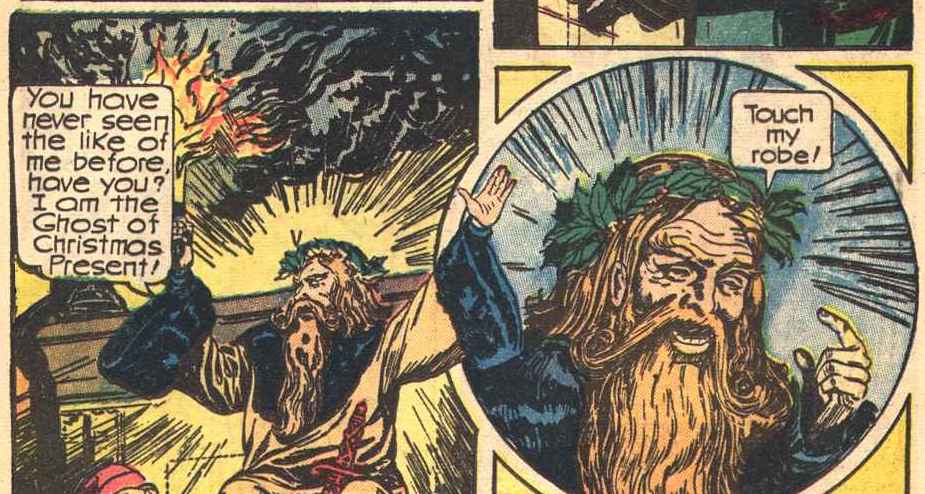
The sumptuous feast from the book is there, but I can't tell if the Ghost is sitting on a throne of food or if he's brought his own chair. He's certainly giant-sized and has the long hair and holly crown of the literary version, but there are no icicles on the crown and the adaptation takes other liberties with his appearance. 

He has a torch, but it's just a regular old torch and not cornucopia shaped. He has the sheath, but there's actually a sword in it, which directly contradicts Dickens. The Ghost's beard covers his chest, so we can't know for sure, but we can imagine that he's shirtless under there. Likewise, his long robe covers his feet and there's no telling if he's barefoot or not. But he could be. 

The most noticable change is the color of the Ghost's robes. Rather than being green with white fur trim, they're light orange with black fur trim. They're pretty striking and I love the black fur trim, but they're not very Christmasy.

Scrooge hasn't shown strong signs of change up to now, but - true to Dickens' text - he tells the Ghost that he learned a lesson the previous night and he's willing to profit by whatever this Spirit wants to teach him. This version of Scrooge was especially mean and businesslike early in the story, so it's nice to see that the small hints of change that he let show throughout Past's visit are signs of something bigger going on in Scrooge's heart.

This version of the Ghost of Christmas Present does invite Scrooge to touch his robe. We don't see Scrooge do it, but we can assume that Scrooge takes that action since the narrative text tells us that "immediately the room vanished and they stood on the city streets on Christmas morning."

Thursday, December 03, 2020

“Another Idol Has Displaced Me” | Classics Illustrated #53 (1948)

The Classics Illustrated adaptation dedicates a couple of pages to this year's scene: one for each vision of Belle. 

In the first one, the break-up scene, Belle and Young Scrooge are fully colored, tangible figures, which is a change from the previous visions. At the school and Fezziwig's warehouse, the figures Scrooge saw were ghostly, white outlines. This vision feels more real and important.

Belle's wearing a blue dress and red roses in her hair, so she's hardly a woman in mourning. The dialogue is abridged, but gets the gist of the conversation across nicely. There's no one incident that seems to have sparked her decision to leave Scrooge and she doesn't even suggest that his feelings towards her might have changed. She's just noticed his greed and wants nothing to do with the man he's become, though she's sad about it and doesn't wish him any harm.

Scrooge is visibly upset by the memory and covers his eyes in one panel. But the text points out that the Spirit "forced him to observe what happened next," and on the next page the Ghost has its hands on Scrooge's arm. The Ghost is physically smaller than Scrooge (which is faithful to Dickens), so Scrooge looks like he could get away if he wanted to, but he's compliant. The Spirit's "forcing" him to watch probably isn't an act of physical restraint in this version, but just evidence that Scrooge has accepted the Spirit's authority.

The vision of Belle's family goes back to the white, transparent figures for a panel, but they solidify and gain color in the next. We probably shouldn't read much into that, but I'm still interpreting it as this is a vivid, important vision, though we got to see a hazy, ephemeral image as one scene transforms into the next.

Belle's family is reduced to her husband and one, smiling, quiet baby in this version, so there's no large, boisterous bunch. Belle's husband doesn't ask her to guess which old friend he saw earlier, but she guesses anyway and gets it right, of course. The husband mentions that Marley is near death and that Scrooge is quite alone in the world. Their pity causes Scrooge to cry out in terror according to a caption and ultimately to spring upon the Ghost. But as Dickens wrote, there's really no contest and the Ghost seems untouchable.

There's no final, shocking transformation by the Ghost into the various faces from Scrooge's past. And since this version of the Ghost never had an extinguisher cap, Scrooge doesn't get to use it to try to snuff the ghost out. Scrooge simply takes a run at the Spirit and then is asleep in the next panel, with a caption saying that he "was conscious of being in his own bedroom" before drifting off. 

Monday, December 02, 2019

“Why, It’s Old Fezziwig!” | Classics Illustrated #53 (1948)


Index of other entries in The Christmas Carol Project

The Classics Illustrated version is only a page-and-a-half, so as usual with this adaptation there's not much room for anything but laying out facts. And as with the schoolhouse scene, Fezziwig's warehouse and its inhabitants are just colorless, ghostly outlines: figures for Scrooge to observe, but there's no temptation to interact with them.

Fezziwig is a slightly overweight, jolly-looking man in an old-fashioned powdered wig. We see him at his desk, but only in close-up, so there's no telling how high the desk might be.

Dick Wilkins is named and a caption box identifies him as Scrooge's fellow apprentice (with a note to young readers that an apprentice is "one who is learning a trade"). There's no sense of Scrooge and Dick's relationship other than co-workers. Scrooge is excited to see him, but he's been enthusiastic about all of these visions so far. He might just be into the experience of seeing these memories brought to life. Although we did see signs of (supernaturally assisted) empathy at the schoolhouse, so maybe that's genuine pleasure Scrooge is feeling about seeing a former chum again.

Fezziwig instructs the boys to clear away the shop for the party, but we skip right past the preparations and go straight to a single panel of Scrooge watching ghostly people dancing. There's no mention of who any of them are and you can't even see the fiddler. Certainly there's no Belle.

There's also no sign of Fezziwig's being an especially kind person. He is kind and he certainly loves Christmas, but there are no signs that he takes a special interest in Scrooge or anyone else. There's not even a conversation between Scrooge and the Ghost about Fezziwig's effect on his employees. He's just a good, nice boss. 

Scrooge enjoys watching the party though and a caption tells us that "his heart and soul were in the scene." He's not necessarily learning any more empathy, but the Ghost is at least successful at lowering Scrooge's defenses and making him less mean. It's a small victory though and I still feel like this Scrooge has a long way to go before he sees a real need to change.

Of course there's no scene of Young Scrooge and Dick cleaning up after the party. Old Scrooge is still enjoying the scene when the Ghost says that they need to get moving. Time is growing short.

Monday, December 03, 2018

“I Was a Boy Here!” | Classics Illustrated #53 (1948)


Classics Illustrated is trying to be faithful to Dickens and has Scrooge and the Spirit walk through the wall of Scrooge's room to appear immediately in the countryside.

This version of Scrooge has been especially mean and businesslike, so it's surprising that he actually does cry in this scene. He doesn't enjoy the Merry Christmasing like in Dickens' version though and his tears are mostly in pity for himself as a child. He's feeling sorry for himself, in other words. Connected to the way Scrooge has behaved so far in this version, I read it as a selfish reaction. At least initially.

To Dickens' description of Scrooge's being "neglected" by his friends, Scrooge adds the word "shunned." That kind of treatment makes them more schoolmates than "friends," but children use the word "friends" to refer to schoolmates, even when they're not acting particularly friendly. I think that's how this Scrooge uses it. Or perhaps he's saying that he felt shunned. Either way, it's safe to say that none of these kids have reached out to him in any sympathy for his having to stay at school over Christmas. Earlier, when Scrooge sees the kids leaving school, he just says that he knows them; not that he has any real relationship with them. He seems to be excited, but that's probably just the thrill of being plopped into so vivid a recreation of his memories.

A note on how Classics Illustrated depicts the "shadows of things that have been": All the people in these scenes of the past are colorless, ghostly outlines. It's not my preferred way of imagining it, because it doesn't make as much sense that Scrooge would forget they're not real and try to interact with them. But it's a decent visual representation of what Dickens describes is going on.

There's not enough detail in Scrooge's school to see if it's run down or not. We go straight from the countryside to inside the schoolroom, so we never see the exterior. Some furniture inside has color to it, so I don't think that the building is supposed to have the same ghostly form as the people in it, but the lines representing the Spirit's brightness overpower the rest of the drawing, so we can just tell that it's a schoolroom, but not its exact condition.

All of Young Scrooge's literary companions show up - even Valentine and Orson - but there's no context for them. The Spirit just says, "Remember those characters?" and Scrooge says that he does and excitedly names them, but there's no solid suggestion that they're replacing real, human friends for Scrooge. You have to imply it.

Helping the implication is that Scrooge gets sad again after these visions. A caption explains that he's "seized with pity for his former self" and he's crying, "Poor boy! Poor, poor boy!" It sounds like Young Scrooge is the poor boy, but in the same word balloon he adds, "I wish, but it's too late now..."

The Spirit asks him what the matter is and he explains about wishing he could have tipped the boy singing the Christmas carol. Incidentally, Classics Illustrated left out that earlier encounter, but it's easy to imagine that it happened, and probably has many different times with different singers. It would be effective though to contrast the image of that lone caroler with the lonely Scrooge in his schoolroom. I don't remember any adaptations that do that, but it could be powerful.

Some adaptations changed the caroler to a group of carolers, some including women or girls, so the comparison wouldn't work with those. But that's possibly another reason why a lot of adaptations leave out this particular regret of Scrooge's.

At any rate, this moment is the first sign of real change in Classics Illustrated's Scrooge. It's the first time that Scrooge has thought about anyone but himself, so it's important. And the catalyst for it is all from within him. Bringing Scrooge back to the past hasn't reminded him of friends and a time when Christmas was still special to him. It's been nothing but a reminder of his own loneliness as a child. And somehow he's connected that with the kid outside his office. There's not an in-story explanation for it, so it has to be the result of the Spirit's touching Scrooge's heart earlier. That's not as cool as Scrooge's coming to it through more natural means, but this wicked, resentful Scrooge needs extra, supernatural help to get to where he needs to be.

When Fan shows up, she looks younger than Scrooge, but not exactly childlike. I'd put her in her early teens with Scrooge maybe a few years older. She says nothing about Scrooge's father, just that she's there to bring Scrooge home. Her joy at coming to get him implies that he's been on some kind of exile from home for a while, but there's no explanation of why Scrooge has been cast out (if that's even what happened). All we know is that he's been lonely at school, but now he's headed home.

Since Scrooge's father isn't part of the story, there's no need to wonder what happened to Scrooge's mother and no reason to connect that with what happened to Fan. The Spirt mentions that Fan died an adult and Scrooge concedes that she had one child, his nephew.

There's no mention of the schoolmaster either. They go straight from the schoolroom to a particular warehouse...
Wednesday, December 06, 2017

“Your Reclamation, Then” | Classics Illustrated #53 (1948)


Faithful to Dickens, Classics Illustrated does take a few panels to have Scrooge wake up, experience the sped-up progression of time, and fret about it.

It abandons the old-young Spirit though and goes for a youthful specter with long, blonde hair. Something I didn't mention yesterday was Dickens' refusal to assign a gender to this ghost. He always refers to it as "it." Visual depictions are going to have to decide what to do about that and Classics Illustrated cleverly chooses an androgynous look.

The Spirit has the holly branch in this one and that bright light effect is part of its appearance in every panel, but there's no extinguisher cap. Which is probably good, since this version of Scrooge is one of the meanest and least sympathetic. I wouldn't be surprised to see him extinguish the Spirit's light if he had the opportunity. So the story doesn't give him one.

It also abbreviates Scrooge's conversation with the ghost. Scrooge stammers his initial question about the Spirit's purpose (the old man is clearly scared; there's just not any evidence of change yet) and the Spirit answers that it's there for Scrooge's "welfare and reclamation." That robs Scrooge of his humorous line from the book about a night of unbroken rest. But the Marley scene also removed Scrooge's sense of humor. This Scrooge is all business.

The conversation is so abridged that the Spirit doesn't even explain that it represents Christmas Past. We'll have to pick that up through its actions as it takes Scrooge on tour. [UPDATE: As Caffeinated Joe points out in the comments below, not only does the Spirit announce itself, it does so in the panel I included on this post. I'm a dork.] 

It does take a panel to touch Scrooge's heart though. Or rather, to point at Scrooge's heart. We never see the actual touch. The implication is that it happened though, since Scrooge and the Spirit are outside in the next panel. We'll just have to wait to see if the touch had any effect in "upholding" the old man.

Saturday, December 03, 2016

“More of Gravy than of Grave” | Classics Illustrated #53 (1948)


Index of other entries in The Christmas Carol Project

Since we're starting with the comics, there probably won't be any knocker-to-face transitions to comment on. Comics would be especially good at no "intermediate process of change" simply by showing the knocker in one panel and Marley's face in the next. To contradict Dickens with an actual transformation would take multiple, precious panels. Classics Illustrated doesn't even show the two different looks of the knocker. The first time we see it, it's already got Marley's face. Although in the next panel, the face is gone again.

There's no mention of the hearse or the width of the stairs. And the one panel that shows Scrooge's ascent is angled so that we don't really get a good look at the stairs at all. But once Scrooge is upstairs, the comic does treat us a few panels of his checking out his rooms; even the "suspicious attitude" of his dressing gown.

His fireplace has no Dutch tiles, much less images of Marley inhabiting them, but Scrooge does still dwell on Marley's face as he eats his gruel (which a helpful caption box explains is "boiled cereal"). Scrooge gets up and paces a bit, restless in his fright.

I like how this version builds suspense with Marley's journey upstairs. As in Dickens, Scrooge hears sounds from the lowest levels of the house. One caption mentions that the clanking is coming from "deep down below," suggesting Hell as much as the cellar. But there's also a panel that shows the cellar (this one stores coal, not wine as in Dickens) with a couple of mice watching lines that represent either mist or the passing of some unseen being. There's a nice feeling of dread, especially considering how abbreviated this version is in other areas.

Marley moves into Scrooge's sitting room through the locked door and there's even a panel of him halfway through like Kitty Pride. Marley is colorless and see-through. Since the images are static, there's no personal wind or atmosphere around him that we can see, so we'll skip that for the comics. When he pulls off his bandage, his mouth does open to a natural degree.

Scrooge explains that he doubts his senses, but there's no humor in it. Even the gravy/grave pun is gone. All the dialogue is heavily abridged and there's even a panel with nothing but text that sums up the conversation. At the end, Marley schedules the coming ghosts as in Dickens: over a span of three nights.

Marley flies out through the window and Scrooge sees other phantoms, "many of whom had been known to Scrooge in their lives - all misers," but none of them are trying to help anyone else. The implication is simply that Scrooge is destined to become a ghost if he doesn't change. The comic doesn't sell the helplessness of that situation; turning into a phantom is supposed to be scary enough.

And that fits this portrayal of Scrooge so far. As we noticed earlier, this Scrooge isn't actually miserable. He's just a mean, proud man who seems to resent getting old. Which makes Marley a reminder of Scrooge's mortality. Marley's visit shakes Scrooge, but there's no sign yet that Scrooge is ready to change anything. He sees the coming ghosts as something scary and unpleasant to be mandatorily endured, not as an opportunity to learn anything.

Wednesday, December 02, 2015

His Usual Melancholy Tavern | Classics Illustrated #53 (1948)


Unsurprisingly, Classics Illustrated cuts the part about dinner and has Scrooge go straight home. It does mention though that Scrooge inhabits a set of rooms instead of a whole house, but not that the other rooms are all offices. It also adds that Scrooge's suite used to belong to Marley.

It doesn't show us much of the building though, simply saying that it's in "a dreary section of the town." Not much room for showing in this comic.

Classics Illustrated does add one thing to the scene and that's a reminder that Scrooge thinks Christmas is a humbug. In Dickens, Scrooge isn't obsessing about the holiday, but here it's still very much on his mind.

Friday, December 05, 2014

"If Quite Convenient, Sir" | Classics Illustrated #53 (1948)


In the interest of condensing the story to 45 pages, Classics Illustrated cuts out all the scene- and mood-setting, so there's no sliding scene or even a crowd scene on the street. There's not even an incident where Scrooge menaces any carollers. Instead, the comic goes straight from Scrooge's dismissal of the charitable solicitors to closing time.

Writer George D Lipscomb and artist Henry Kiefer have Scrooge and Cratchit leave the shop together, which fits with how they've portrayed the characters so far. Their Scrooge is a proud man who resents getting old and having less time to enjoy his wealth. Cratchit explicitly hates his job and his boss, but feels powerless to leave. Scrooge has threatened Cratchit's job a few times already; enough that Cratchit probably doesn't take him seriously. All that adds up to a couple of men who can't stand each other, but are aren't in any real danger of splitting up. They aren't at all equals in status, but they're more or less equals in power. Look at the way Cratchit openly glares at Scrooge in the second panel above. He can't stand the man and he's not afraid to show it.

When Scrooge brings up the day off, it's just a matter of making it official. He's not checking; he knows Cratchit must have it, but he also wants to remind Cratchit how he feels about it. His bringing it up is just his way of opening the door so he can complain. And Cratchit knows it, too. His "If quite convenient, sir" is a social obligation, but it's clear from his expression that he doesn't care if it's convenient or not.

There's no sympathy we're supposed to feel for this version of Scrooge. He's not actually miserable; he's just mean. He hates Christmas because the values it brings out in society are diametrically opposed to Scrooge's own. It's as simple as that and we're not meant to relate to him.

Thursday, December 05, 2013

'You Wish to Be Anonymous?' | Classics Illustrated #53 (1948)


George D Lipscomb and Henry Kiefer's adaptation for Classics Illustrated only gives five panels to the charitable solicitors and cuts out huge chunks of the dialogue. They don't even have time to get confused about whether Scrooge is going to contribute. He makes it very clear that he won't and they very briefly try to change his mind before they give up and leave.

It's a perfunctory presentation, which is probably the point. Part of the value of the shorter adaptations is seeing what they think is crucial to the story. Lipscomb and Kiefer wanted the solicitors so that Scrooge's wider selfishness is seen (as opposed to his narrower selfishness about Christmas), but saw no need for Dickens' nuance.

One thing this version reminds me of is that the men are "portly." That's right out of Dickens, but I glossed over it earlier. These are not people who deny themselves pleasure as a matter of habit. They're not skipping meals so that others might be fed. I think it's interesting that Dickens specifically calls that out, though he doesn't judge them for it and neither will I. Perhaps he just means to suggest that they're wealthy before they open their mouths, but I like the question that it raises even if I don't have an answer ready in response. How much should the wealthy give up for the sake of the poor?

Tuesday, December 11, 2012

'Merry Christmas, Uncle!' | Classics Illustrated #53 (1948)


I did this last year, too, but I forgot Classics Illustrated #53. I think I've got that fixed so I won't do it again next year, but here it is, out of chronological order.

Classics Illustrated devotes two pages to Fred's introduction.The nephew is drawn young and cheery; carrying a Christmas wreath and wrapped packages. He's not overly jolly, but he's obviously enjoying the holiday season and doesn't seem to resent the duty of coming to visit Scrooge. The text says that he "suddenly" announces himself, so there's the abrupt entrance.

The conversation is true to the text for a while, with only minor edits, until it gets to Fred's speech, which is trimmed way down to fit into a single panel. Cratchit's reaction to the speech is pretty funny, but unintentionally. He claps, Scrooge threatens his job, and it's at that point that Cratchit starts poking the fire and accidentally makes it go out. Unlike Dickens' version, the fire's going out isn't what's funny in the scene. In fact, because of the way the panel is colored with bright yellow and orange filling the fireplace, it's impossible to tell visually that there's not a raging fire in there. Only the caption box explains what's going on, so the joke is lost. What's funny is Cratchit's humbly poking the fire and thinking to himself, "When will I ever learn to control my emotions?" Indeed, Bob.

It doesn't look like Cratchit's genuinely afraid for his job though. Scrooge is unpleasant, but he's already threatened Cratchit a couple of times in this adaptation, so one would think that those threats are pretty toothless by now.

I was pleasantly surprised to see that Scrooge does finish the "I'll see you in Hell first" line in response to his nephew's invitation, though he substitutes "Hades." It's kind of odd that they choose to keep it, because the rest of their conversation is severely trimmed down in the last part of the scene. There's no discussion of Fred's wife or any hints as to why Scrooge dislikes his nephew. It's just, "Come to dinner," then, "Go to hell." Fred takes off right after that.

Without any other clues, Scrooge's refusal is all about Christmas and not about his nephew. That's the second time we've seen this in an abridged version, and I bet it won't be the last.

Thursday, December 15, 2011

Old Sinner: Classics Illustrated (1948)


I forgot one! I don't know how Classics Illustrated #53 slipped off my list, but it did and I need to come back and pick it up. It's the first of five comics adaptations we'll look at and since it's Classics Illustrated, it's arguably the most famous. George D Lipscomb wrote the adaptation and Henry Kiefer illustrated it. If you want to read ahead, the Dickens Christmas website has the whole thing.

All the scene-setting is done on a splash page that - by spoiling the rest of the story - reveals that it expects the reader to already be familiar with it. Surrounded by characters from the tale, including the Ghosts of Marley and Christmas Past, a prologue gives us a description of Scrooge's personality and reveals that his partner Marley is dead:
The immortal Christmas "ghost story" portraying the hair-raising experiences of Ebenezer Scrooge, a stonyhearted old skinflint, who lives solely to satisfy his own material wants and scoffs openly at the spiritual pleasures of his fellow-men.

His partner, Jacob Marley, a long time dead and buried, Scrooge carries on the business by himself, even though the sign above the warehouse still bears the legend, "Scrooge and Marley."

One cold bleak and biting afternoon, the day before Christmas, finds Scrooge at work in his counting-house.
One thing I've noticed is that Lipscomb introduces an overt assumption about the source of Scrooge's problem. Dickens lets us know that Scrooge is grasping and covetous, but doesn't say anything at first about why he's that way. That leaves a lot of room for interpretation by adapters and we've already noticed some differences in posture, which is really just another way of talking about Scrooge's presence. Some film Scrooge's are small and miserable men; others are imposing and proud. Lipscomb's "lives solely to satisfy his own material wants," which puts him more in the "proud" category. What's more, it means that Scrooge isn't a true miser.

It's going to be interesting to see how various interpretations mix and match these traits: pride vs misery; material indulgence vs extreme frugality. Scrooge is famous for being a miser, but do all adaptations portray him that way? Something to keep an eye on.

On the second page, the comic reveals that Scrooge and Marley has had a very good year before introducing us to Scrooge's unnamed, freezing clerk who wants to replenish the fire,


Kiefer's Scrooge looks like he should be introducing Tales of the Crypt. He berates the clerk for his age twice on the page; something that I've never seen in the character before. This Scrooge openly delights in his money, but envies youth. That's another strong motivation for him to be the way he is. And, I extrapolate, a strong motivation for him to change in the end. He doesn't have much time left to enjoy his wealth and resents it. The Spirits will reveal to him a way to get pleasure that also offers a purpose.

In the first panel of page three, the clerk returns to his desk to warm his hands on his candle and mutter about Scrooge. This clerk shows a cynical side that we don't see in other versions. He calls Scrooge an "old miser" (which is understandable given the circumstances even if it's not technically correct) and says that if he didn't have a family to think of, he'd leave Scrooge and "his wormy old books." These thoughts are interrupted by a sudden visitor to the counting-house.

LinkWithin

Related Posts with Thumbnails