Showing posts with label matthau christmas carol. Show all posts

Monday, December 13, 2021

“Come In! And Know Me Better, Man!" | Walter Matthau (1978)


Rankin-Bass' version of The Stingiest Man in Town ended the previous scene with Scrooge falling asleep in bed as usual. But instead of immediately having him wake up again, the story cuts outside to Scrooge's window where our old friend BAH Humbug is peering in and wondering how Scrooge got back. He stayed behind when Scrooge left with the Ghost of Christmas Past, so he's not as caught up on events as we viewers are. 

Just as Humbug is trying to figure this out, the big, nearby church clock strikes One and worries the little bug. Inside, though, Scrooge is still fast asleep and not thinking at all about the impending arrival of the next ghost. In fact, he's awakened by the Spirit's boisterous, jolly laughter coming from the next room. Scrooge wonders what the sound is, but Humbug knows. "Looks like the Number Two Ghost is right on time!" I think that's a random train schedule joke and if it is, I like it.

Scrooge still isn't getting out of bed, so the door to his room opens on its own and a bright, yellow light pours in just as the TV special cuts to commercial. When we come back, Humbug is now inside and looking toward the open door and the bright light alongside Scrooge. 

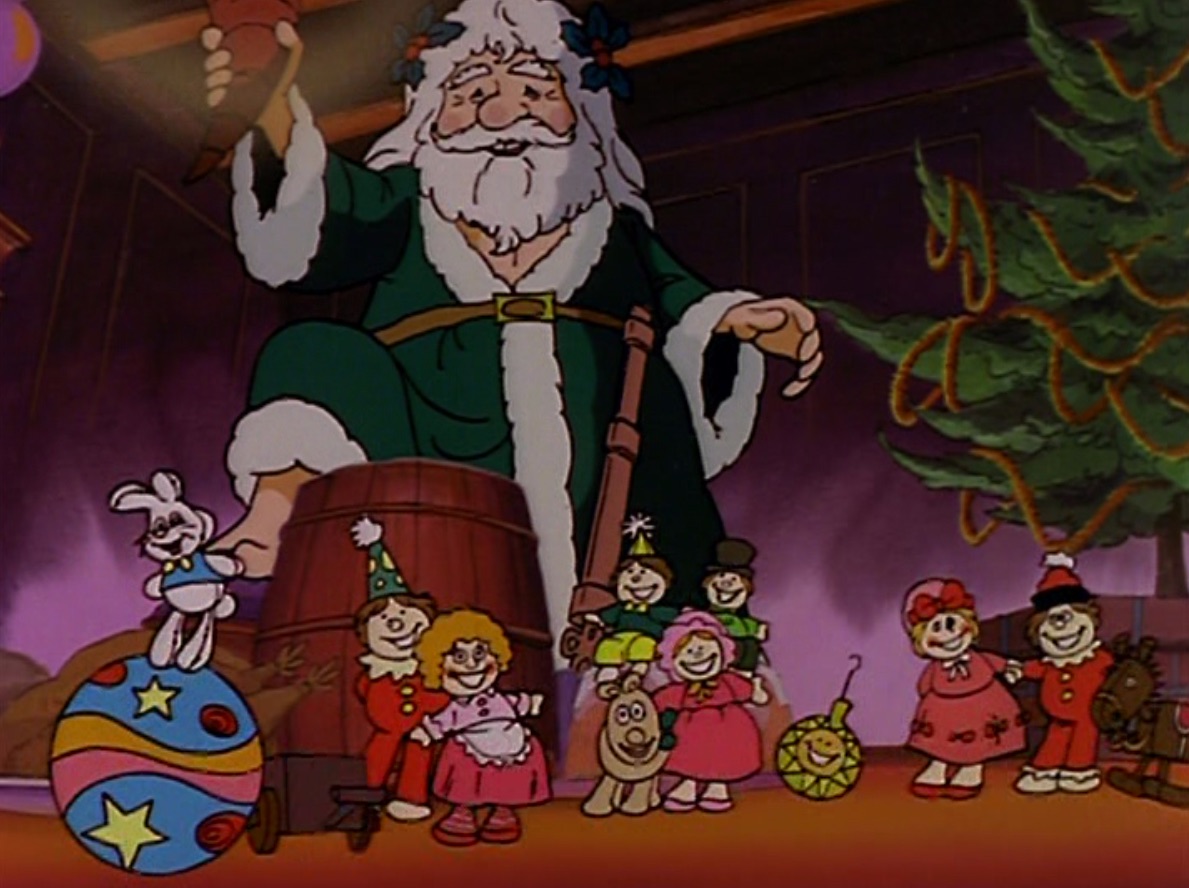
Scrooge finally gets out of bed and goes to check things out, where we see his redecorated parlor. It's not covered in food, but there's a festive tree next to a table that has a candelabra, a couple of empty wine glasses, and a couple of dishes heaped with meat and fruit. The camera pans across the room to reveal the Ghost standing over a cake, a big cooked bird of some kind, and scattered grapes and potatoes. There's a barrel, presumably filled with wine, and the Ghost has a big, bare foot propped on something round that could be another food container or maybe just a piece of furniture. 

The Ghost is so big that we don't see his face at first, but he's barefoot, has the empty scabbard (not particularly rusted), and his robe is the right colors. He introduces himself as the camera pans up to reveal his broad, bare chest, his standard cornucopia torch, and his holly crown. There are no icicles on the crown, but the biggest alteration from Dickens' version is that this ghost has long, white hair and beard instead of brown. Like with the Marvel Comics version, I assume this is to suggest Santa Claus to North American kids in the audience. As he invites Scrooge to come and know him better, the camera pulls back to reveal his full form.

Since this is a musical version, we get a song here to explain what this Ghost is about. It's not sung by the Ghost himself though, but by toys and ornaments on the Christmas tree that come to life and dance around. It's a fun, earworm of a song with a chorus that goes:
"Listen to the song of the Christmas Spirit,
Can't you hear it? Can't you hear it?
Listen to the song of the Christmas Spirit,
Ringing in the air."
I won't reprint the entire lyrics, but a typical verse goes:
"Tinkling laughs of girls and boys
Mingle with the jingle of tinkling toys.
Words of hope and happy times
Sung to the music that chimes."
The point of the song is in the line: "Can't you hear it?" They're asking Scrooge why he can't hear the joy and spirit of Christmastime. Another line goes, "Boys and Girls can sing it too. They sing this song. Why can't you?"

Scrooge is distraught at first and asks the Spirit to stop the singing toys, but instead the Spirit hits Scrooge with a fireball from his torch (which is also what he used to bring the toys to life). Scrooge shrinks to toy (and Humbug) size and the toys quickly come over and pull both Scrooge and Humbug into the dance. Scrooge resists at first, which leads to some slapstick, but Humbug listens to the sound and joins in quickly. And before long, Scrooge has become caught up too and is enjoying himself with Humbug and the rest.

This version leaves out Dickens' line about Scrooge's wanting to continue learning what the previous Ghost taught him, but we see the same basic effect. Scrooge was frightened and saddened by his glimpses at the past, but having been torn down from that experience, he's already being built back up here before this Spirit shows him a single thing. 

At the height of these shenanigans, the Spirit scoops up Scrooge and the Humbug and tosses them out the window where they fly over the city. Scrooge returns to his normal size and is concerned that he's going to fall, but the Spirit (who has followed them out the window) commands Scrooge to "touch the hem of my coat and be lifted."

The "hem" reference is interesting, because it's not from Dickens. It's from a couple of instances in the Gospel of Matthew that refer to people being healed by touching the hem of Jesus' garment. I noticed in the Marley scene that this version is more overtly Christian in its language than other versions, so I imagine that it's making an intentional connection between the Spirit of Christmas Present and the spirit of Christ's teaching. Properly manifested, both have the power to heal.

Thursday, December 10, 2020

“Another Idol Has Displaced Me” | Walter Matthau (1978)

In Rankin-Bass' version of The Stingiest Man in Town, we've already met Belle at Fezziwig's party. In fact, the party was mostly about her and Scrooge's relationship and we got a whole song revealing their very different dreams for their future together. They didn't seem to mind and ended that song in a kiss, but Old Scrooge looking on wept openly and said that he shouldn't have remembered.

But, as the Spirit says, "There is another Christmas." He takes Scrooge forward to when he'd just formed his partnership with Jacob Marley. "Your business was new," the Ghost says, "but your ways were set." 

Scrooge begs, "Oh, Ghost, spare me the rest!"

But the Ghost is unrelenting. "You must drain the cup to the dregs." I like that image.

They materialize at Scrooge and Marley's office and Scrooge moans pitifully as he realizes what he's about to see. Inside, Belle (in a bright, blue dress, not mourning black) complains about "another idol" and this version quickly deviates from Dickens by having Young Scrooge scoff that she's being overly dramatic. He's working and is more interested in complaining about how he's losing money than he is in listening to her.

Belle tries to get him to lighten up about some potentially defaulting loans by reminding him that it's Christmas. Scrooge goes nuts and rants about Christmas, finally declaring that it's a humbug (and suggesting that this incident is the origin of that expression).

That's when Belle declares that she's breaking up their engagement. It makes it sound a little like it's his attack on Christmas that finally does it for her, but you can also read the scene as she came here to break up and his Christmas rant is the excuse she needs to finally come out with it. "You have become someone I do not know. Someone I do not wish to know."

She breaks into another song, "It Might Have Been," to spell out what he's giving up. And as she sings, we see images of their potential life together: hanging out in a cozy room decorated for Christmas and with a fire blazing in the fireplace as their two children rush in for hugs, presents, and kisses. 

As Belle runs crying out of Scrooge's office, he picks up the song in a voiceover. The actual Young Scrooge doesn't know what he's missed, but in the language of the musical it's clear that he'll eventually come to regret this night.

The image goes split-screen with Scrooge continuing to work in his office and Belle running through the empty streets of London. Both characters age before our eyes (with dramatic, crashing waves indicating time jumps) and the song closes with Old Walter Matthau Scrooge alone in his office like at the beginning of the story while Belle - also old and alone - wanders the streets without any purpose. No happy ending for Belle this time. This evening has ruined them both.

The Old Scrooge with the Ghost sobs that he cannot bear any more and grabs the extinguisher cap. He quickly jams it over the Spirit's head before the Spirit can even react and then the scene cuts to Scrooge in bed snuffing out a small candle with a little extinguisher.

Wednesday, December 11, 2019

“Why, It’s Old Fezziwig!” | Walter Matthau (1978)


Rankin-Bass' version skipped over the schoolhouse scene and had the Ghost fly Scrooge directly to Fezziwig's. The party is already in progress, so Dick Wilkins is not mentioned, nor are any of the partygoers named. Even Fezziwig himself is never named, though we see his name on a sign at one point. The old fellow is dancing at the party with his wife, but you already have to know who he is. He's jolly and fat and has white curly hair. He might be wearing a wig, but if he is it's neither Welsh nor one of those traditional pig-tailed wigs.

The fiddler is up on a desk in the background, but the focus of the scene isn't on the party at all and especially not on Fezzziwig. In fact, this could be any Christmas party. What the scene really cares about is Young Scrooge's relationship with Belle, whom he's dancing with. Old Scrooge remembers that he and Belle had gone outside to cool off after the vigorous dance and we get to hear their conversation. Belle wants to get married right away, but Scrooge wants to put it off until he's more financially secure. They sing a song about their dreams: hers of a humble little cottage and children; his (which we see represented onscreen) of a large, golden mansion and no kids.

Old Scrooge is very upset by all of this. He's been frightened since Marley and is willing to change; he just doesn't know how. He knows what's coming next and he dreads seeing it. He's really being torn down by this.

With all that going on, the Ghost doesn't bring up Fezziwig's relationship with Scrooge or lead Scrooge to compare it to his own relationship with Bob Cratchit. Scrooge's impetus to change so far hangs all on his putting money before love, but specifically romantic love. Which, if you're going to simplify the story, isn't a bad way to go. The money vs love choice is the heart of A Christmas Carol. Eventually Rankin-Bass will need to translate Scrooge's emotions about Belle to a more general love for humankind, but we'll see how (or whether) they succeed in that.

Monday, December 10, 2018

“I Was a Boy Here!” | Walter Matthau (1978)


Rankin-Bass' The Stingiest Man in Town doesn't include this year's scene, but it does have a transition sequence where the Spirit flies Scrooge out of the window and over a surreal, unnerving cityscape. Scrooge says something about not knowing where they're going, but that it seems "strangely familiar" to him. Where they end up going is Fezziwig's warehouse though, so we'll catch up with them there next year.

Wednesday, December 13, 2017

“Your Reclamation, Then” | Walter Matthau (1978)


Since Rankin-Bass' The Stingiest Man in Town spent so much time on Marley, it keeps this introductory scene incredibly short. We'll have to get to know the Spirit of Christmas Past as we go.

Scrooge doesn't even get a chance to go to sleep. He's still quivering in his bed when the Spirit draws back the curtain and introduces himself. And he's decidedly a man. And an old one.

If you're not going to go all out and do the young-old, genderless representation, I understand the impulse to make the ghost old. Scrooge himself is an old man and this spirit represents all of his previous Christmases, so it makes sense that it's as old as he is. Dickens' adding a youthful quality is just a metaphor for how fresh our memories are. We remember even childhood things as if they were "just yesterday." If you've got to pick either young or old though, I think old is the way to go.

Incidentally, it's just this year that I paid any attention to the Spirit's explanation (which does come up in this abbreviated version) that it specifically represents Scrooge's past and not all Christmases past in general. I used to think the Spirit must have been 1,980-something years old, but really it's only going to be in its 70s or however old Scrooge is.

What I don't accept as much is the decision to make the Spirit male. If you're not going to go genderless, then why not add a woman to the already very male-heavy cast of characters?

The Spirit is small like in Dickens, but not supernaturally so. He just looks like a very short person. And he does carry the holly and the cap and he has the bright light shining from his head. This Scrooge is still terrified, so he doesn't dare ask the Spirit to put the cap on. In fact, he doesn't talk to the Spirit at all except to ask if he represents "long past."

The Spirit doesn't touch Scrooge's heart either. He simply commands Scrooge to take the Spirit's hand and then flies them both out of the window. As we talked about last year with Scrooge's question about "how" to change, I think his heart has already been touched. He doesn't know what he needs to do, but the interest in changing is already there at this point.

As the window opens, Tom Bosley's Humbug character has the chance to come back in, since he was trapped outside during the Marley scene. He watches Scrooge and Spirit go, but stays behind. I don't remember if he witnesses the past with Scrooge, so maybe he catches up later.

Saturday, December 10, 2016

“More of Gravy than of Grave” | Walter Matthau (1978)


Index of other entries in The Christmas Carol Project

Rankin-Bass' The Stingiest Man in Town uses the knocker to go to a commercial break, with its transitioning quickly to Marley's face and then fade to black. The actual knocker is also shaped like the face of an elderly man (weird design) and like Dickens says, there's no intermediary stages of change. The animation just superimposes Marley's face and the switch back is just as abrupt. So it makes sense that Scrooge doubts what he sees. "Just my imagination," he says.

This version skips the walk upstairs and even Scrooge at the fireplace. He's already had dinner at the tavern, so there's no need to show him eating gruel, too. He doesn't search the place or seem scared at all. He goes straight to bed and it's there that Marley's ghost appears in a repeat of the teaser scene at the beginning of the show.

Marley's entrance is different from the way Dickens wrote it, but it's still scary. There are no bells to announce Marley's coming, but Tom Bosley's Humbug character sings about the clanking of chains and the arrival of the ghost.

That night when Ebenezer Scrooge 
Lay dreaming in his room,
He heard the sound of rattling chains
Come clanking through the gloom.

And while he lay there shivering
In the icy wind of fear,
The ghost of Scrooge's partner
Jacob Marley did appear.

As Humbug sings, the candle next to Scrooge's bed takes the place of the fireplace in Dickens and reacts to Marley by lighting itself with an unnatural, green flame. Rather than walk through a closed door, Marley manifests first as a sort of dark blot on the wall that shapes itself into a silhouette and then Marley's shadow before it becomes the blue, transparent ghost of Marley himself.

The animation isn't sophisticated enough to give Marley his own, personal atmosphere that blows his hair, but Marley does pull some scary tricks like making his body disappear and enlarging his head to fill the whole room. That takes the place of his pulling off the bandage, too. Maybe Rankin-Bass figured the gaping mouth would be too much for kids.

Scrooge tries to deny his senses at first, but there's no humor in it. That would humanize him too much and this version isn't at all interested in that. Scrooge is to be judged as an object lesson, not related to or pitied as an actual person. But after seeing the giant head trick, Scrooge begins to believe that he's not just hallucinating.

Since this is a musical, Marley's warning takes the form of a song:

I wear a chain.
A heavy chain
Is wound around my soul
A chain of sin and vices
That I could not control.

Repent your crime.
Repent in time
Or you'll repent in vain.
For if you wait
Until too late, 
You'll never break your chain.

Although my chain is very strong,
The one you wear is stronger.
My chain of wrong is very long,
But yours is even longer.

You must escape.
Escape my fate.
Cast off the sins that bind you
Or you will find when you pass on,
You'll drag your chain behind you.

As Marley sings, there's a montage showing him and Scrooge conducting business, evicting poor families, and eventually Marley's tombstone and Scrooge's continuing to worship money.


Scrooge resists Marley's message at first. He even defends Marley, saying that Marley didn't deserve what's happened to him. But of course he's actually defending himself. When Marley suggests that Scrooge still has a chance at a different outcome though, Scrooge is interested. "How?" he asks.

That's an interesting question to me. Marley's terminology has been overtly religious, repeatedly using words like "sin" and "repentance." By putting it in those terms, he's giving Scrooge some very specific instructions that most people in Scrooge's culture would know how to follow. It means getting to a church, seeing a priest, and starting to work on becoming a better person.

That Scrooge asks "how" tells me that he's rejecting a simple, ritual, surface repentance as his answer. He seems to intuit that Marley's calling for a deeper transformation than that. But he has no idea how to go about it.

Marley's answer of course is that Scrooge will have help. "Tonight you will be haunted by three spirits." No confusing three-day schedule for this children's show. Scrooge says he'd rather not. He's not that interested. He's clearly terrified, but he's going to need some more convincing. And Marley's solution is to terrify Scrooge even further.

Marley goes to the window and beckons Scrooge to join him, but Scrooge refuses to get any closer to the ghost. So Marley waves a hand and Scrooge is floated from his bed and over to the window where Marley shows him an army of spirits who are standing in ranks in the street, staring up at the window. "We seek to do good in human matters," Marley says, "but have lost the power forever." There's no woman and child out there; that's not the point. The scene isn't meant to tug on our hearts; it's meant to scare the crap out of Scrooge. "Repent!" Marley cries, and the army of the damned repeats it. "Repent! Repent!"

Scrooge screams, "No! No!" and runs to hide in his bed as Humbug - trapped outside with the army - pounds on the window to be let back in. It's a chilling scene and the most effectively frightening one we've looked at so far. I have some strong, negative feelings about fear as a motivator, but that's exactly Marley's job and he does it really well in this version.

Sunday, December 13, 2015

His Usual Melancholy Tavern | Walter Matthau (1978)


Index of other entries in The Christmas Carol Project

After Cratchit leaves the office, Scrooge sticks around to put away the day's earnings. Shaking the container of coins, he thinks it sounds a little light and vows to dock Cratchit for anything that's missing. Tom Bosley's Humbug, who's also stayed behind, gets irritated at this and launches into the show's title song.

The show uses "The Stingiest Man in Town" the way The Muppet Christmas Carol uses "Scrooge" earlier in its storyline. As Scrooge makes his way through the city, townspeople (and animals) sing about what a horrible person he is. And it's reinforced by scenes of his acting out his greediness, cheating and tricking street vendors into giving him free stuff. He does stop in a tavern for dinner, but his newspaper is taken from a trashcan and he stiffs his server on the tip. It's not all that melancholy, but remember that this Scrooge isn't especially sad. He's just mean and wrong.

Here are the lyrics and you can watch the video below:

How can anybody be so stingy?
So stingy, so stingy?
How could anybody be so stingy?
He's the stingiest man in town.

Old Scrooge is such a stingy man
The tightest man since time began.
Oh, he's so tight, so tight I say
He wouldn't give a bride away.

It hurts him so to pay one cent,
He wouldn't pay a compliment,
He uses lightning bugs at night,
To save the cash he'd pay for light!

How can anybody be so stingy?
So stingy, so stingy?
How could anybody be so stingy?
He's the stingiest man in town.

When he goes by the children hiss.
No other man is tight as this.
One day he skinned an alley cat
To make himself a winter hat.

He has a house that's very tall,
With flowered paper in the hall.
And for his mother's funeral,
He cut the flowers off the wall.

How can anybody be so stingy?
So stingy, so stingy?
How could anybody be so stingy?
He's the stingiest man in town.

And when his hearse goes rolling by.
No man alive is gonna cry.
But you can bet his ghost will curse,
Because he's paying for the hearse.

And when it's time for him to go,
His soul will travel down below,
And when he gets there you can tell,
Because you'll hear old Satan yell...

How can anybody be so stingy?
So stingy, so stingy?
How could anybody be so stingy?
He's the stingiest man in town.


The Rankin-Bass cartoon is adapted from a live-action musical special that had aired in 1956 on the NBC anthology show The Alcoa Hour. It starred Basil Rathbone as Scrooge and I just watched it for the first time last year. It's good, but I'm too far into this project to want to try to squeeze it in and catch it up to the other versions. Still, for fun, here's the original version of the song. As you can see, it takes a mocking tone towards Scrooge instead of the righteous indignation of the cartoon.


Back to the cartoon, the scene ends with Scrooge's arrival at home. It doesn't bear much resemblance to the one Dickens describes. It's pretty much just a dark townhouse on a block of similar townhouses. There's a little iron fence around a small yard in front, but nothing about it feels secluded.

The scene does turn spooky though as Humbug narrates, saying that "there was something strange about that night" and suggesting that it was supernaturally dark. He paraphrases Dickens' line about the Genius of the Weather sitting in mournful meditation on the threshold, but changes the personification to Death, foreshadowing the ghostly events that are about to take place.

Friday, December 12, 2014

“If Quite Convenient, Sir" | Walter Matthau (1978)


Index of other entries in The Christmas Carol Project

As the title suggests, Rankin-Bass' The Stingiest Man in Town focuses on Scrooge's miserliness. Pretty much to the exclusion of any other possible trait. With it's narrating "humbug" and sappy songs, it's almost purely children's entertainment, which means that they aren't going for a complex Scrooge. All of his conflicts with Cratchit and Fred have been around money and Scrooge's hatred of Christmas (because it's a time for spending money).

For Cratchit's part, we've learned that he's stealing coal from Scrooge, so he's not especially timid. He doesn't respect Scrooge and has figured out how to game the system. Once Fred leaves, Scrooge brings up the topic of the next day off and Cratchit gets downright sassy with him. Instead of "If quite convenient, sir," he says, "I didn't think you'd have to ask."

That leads Scrooge into his complaint about "picking a man's pocket every 25th of December," but he's defending himself to Cratchit. In fact, as he continues, he goes hard for sympathy and even musters up some tears until Cratchit actually relents and volunteers to take the holiday unpaid! Scrooge has no real power, he relies on Cratchit's kindness to get what he wants. He even lets Cratchit go home first and stays himself to lock up. Scrooge's stinginess makes him a man to be pitied, not feared, but I'm not complaining. It's not a very nuanced take, but it's a pleasant change of pace from the darker versions we've been looking at.

There aren't any outside scenes mixed in with this one, but we've already seen plenty of that earlier in the show. Everyone outside is enjoying the holiday. There's no social commentary about the poor; carollers sing out of joy, not for donations. And even though Scrooge hasn't interacted with the singers, he has had an altercation with some kids building a snowman. In this version, Christmas is a universally wonderful time and Scrooge is ridiculous for not getting it.

Monday, December 10, 2012

Merry Christmas, Uncle: Walter Matthau (1978)


As we noticed last time we looked at The Stingiest Man in Town, Cratchit announces Scrooge's nephew as a diversionary tactic to get the boss' attention off himself. Since this happens before Fred can get to the door, some of the nephew's boisterousness is lost, but Cratchit's strategy supports an idea introduced in the previous scene that the clerk has a deceptive side. B.A.H. Humbug has already revealed that he and Cratchit have been smuggling coal behind Scrooge's back for some time. This Cratchit is a wily character, but Matthau's Scrooge is so dull and unpleasant that I don't care.

Fred's jolly enough. In fact, he's literally skipping up the street as he approaches the counting house. Scrooge of course thinks he's a fool, but Cratchit boldly states that he likes Fred. "His smile warms my heart."

What bluster was lost by Cratchit's announcing Fred is picked up again when the nephew (looking sort of like Bilbo Baggins from Rankin-Bass' The Hobbit) bursts through the door, singing. Scrooge turns the number into a duet by disagreeing as often as possible. I'll put Scrooge's lines in parenthesis:

Merry Christmas, Uncle Scrooge!
(Humbug!)
Oh, be merry, Uncle Scrooge!
(Ha! Ha! Ha! Ha!)

(What's so merry on Christmas Day?
The merry money you throw away?
The merry bills you have to pay?
When you say "Merry Christmas," I say "Bah!")

Here's a present, Uncle Scrooge!
(Humbug! I think you are a fool to waste your cash.)

(What's the present you always buy?
A handkerchief or an awful tie?
Look at this tie and you'll know why
When I get Christmas presents, I say, "Trash!")

But everything at Christmas is so jolly
And lively!
The Christmas trees and wreaths of holly...
(Poison ivy!)
The boys and girls who dream about St. Nicholas!
(Saint Nicholas? Ridiculous!)

Don't you like him, Uncle Scrooge?
(Humbug!)
Good old Nicholas?
(That's a lot of slush!)

(I abominate old Saint Nick.
His reckless spending makes me sick!
I think St. Nick's a lunatic!
When you say, "Old Saint Nicholas," I say, "Bosh!)

As they sing, Fred does indeed give Scrooge a tie that Scrooge tosses at Cratchit. The nephew also offers a poinsettia and Scrooge throws that to the ground, smashing it. The gift-giving is an interesting addition to Dickens' story and I almost wish that some of the other versions tried it just to see how their Scrooges would've reacted. Matthau's reaction sort of makes sense in light of Scrooge's principles, but I could also believe a Scrooge who selfishly kept the gifts rather than refusing or destroying them.

I also like what the gift-giving does to Fred's reason for coming to see Scrooge. This isn't some half-hearted attempt made from habit (as in Richard Williams' cartoon). It's obviously an annual occurrence, but a sincere one. Even if his gifts do kind of suck.

The song takes a short break while Fred invites Scrooge to Christmas dinner. Scrooge refuses, but his reason is again all about the occasion, not about Fred himself. In this simplified version, his only beef with his nephew seems to be about the holiday, but it defines their relationship.

Oh, don't you like a juicy Christmas turkey?
(Detest it!)
Plum pudding with a brandy sauce?
(Can't digest it!)
You'll get a mellow feeling for humanity.
(Humanity? Insanity!)

You'll enjoy it, Uncle Scrooge!
(Humbug! It may be fun for you, but not for me!)

(I'm not merry on Christmas Day.
I'm never happy; I'm never gay.
If you think I could feel that way,
Then you are just as stupid as can be.)

(If you think I'd be merry
And chirp like a canary,
Then you are even dumber than a dumb bug.
When you say, "Merry Christmas," I say, "Nonsense! Fiddlesticks! Poppycock!"
And just plain, "Humbug! Humbug! Humbug! Humbug! Humbug!")

Fred gives up after that, but tells Scrooge that he pities him. "Maybe I'll never be as rich as you," he says, "but I'll go to my grave still believing in a Merry Christmas."

That's where Scrooge starts his "Good Afternoons" as Fred continues throwing laudatory adjectives in front of Christmas until Scrooge throws him out. All the best lines have been cut out of their conversation in favor of the song. Disappointing, but not surprising.

Wednesday, December 14, 2011

Old Sinner: Walter Matthau (1978)


In the '70s, there was no competing with Rankin-Bass for televised animation, whether hand-drawn or stop-motion. They were everywhere: from Christmas specials like Rudolph and Santa Claus is Coming to Town to classic literature like The Hobbit and their Festival of Family Classics series. So, it didn't shock me to learn that they also had their turn at A Christmas Carol. Their casting of Walter Matthau as Scrooge was a bit of a surprise though.

Rankin-Bass' wasn't the first to be called The Stingiest Man in Town. It borrows its name from a musical TV version that starred Basil Rathbone as Scrooge (which I'm gonna have to get and watch now). I don't know how Rathbone's goes yet, but the cartoon opens in the traditional, Christmas Carol way with snow falling over the Victorian London skyline. You can recognize St. Paul's of course, but Big Ben is also there to clue you in, especially if you're a younger viewer.

It should be interesting to compare this with Mickey's Christmas Carol. As with Shower of Stars and the Chuck Jones version, it'll be interesting to watch the cuts and see how they keep The Stingiest Man in Town short enough for TV (though this was an hour-long special, so they have more room than some of the others). I'm especially interested though in seeing how Rankin-Bass' version is different from Disney's, the only other animation studio putting stuff out with anywhere near the frequency and popularity of Rankin-Bass at the time. I'm very familiar with Disney's version and know that since its primary purpose was to entertain, they took some major liberties with the story. Rankin-Bass's adaptations of classics took liberties too and certainly sought to be entertaining, but they also had an educational component to them. Or maybe I'm mistaking schmaltz for a serious side. Either way, that should create a very different feel from Disney's.

Back to the story, the London skyline gives way to a Christmas street scene with carolers singing a typically upbeat Rankin-Bass tune in front of wreath-filled windows. I can't embed video for it, but you can see the first part of the special and hear the songs on YouTube.

Holly Ho!
Holly Ho Ho Ho!
Holly Ho! Holly Ho!
Sing a Christmas carol written long ago.

As they sing, the view changes to a large house, also decorated for Christmas. There's a fire blazing in the fireplace, the table is set for Christmas dinner, and presents fill the space beneath a decorated tree. Above the tree, the camera zooms in on a small, anthropomorphic insect who's dancing in the rafters and joins in the song. Any child of the '70s will immediately recognize the voice as Tom Bosley from Happy Days.

He wishes us Merry Christmas and welcomes us to "the merry household of the kindest and most generous man in town, Ebenezer Scrooge." He acknowledges our surprise at that title, but asks us to take his word for it. By way of credentials, he introduces himself as B. A. H. Humbug, Esq. Rankin-Bass may have sought to educate, but they knew their audience and loved to throw in friendly, celebrity narrators or cutesy animal sidekicks; sometimes - like here - both in the same character.

Humbug concedes that Scrooge wasn't always so jolly. As he explains how Scrooge used to be, the scene changes to another snowy, London street where children are building a snowman in front of Scrooge & Marley's counting house. Humbug quotes Dickens ("Now Marley was dead to begin with.") while explaining that Scrooge kept Marley's name on the sign because he was too cheap to paint it out.

Inside the counting house, Scrooge - looking very much like a bald, white-headed Walter Matthau - smiles and plays with his stacks of coins while his humble-looking clerk writes at another desk. The Humbug sings:

There was a mean and stingy man
Named Ebenezer Scrooge. 
His heart was hard and cold because
He was the Devil's stooge.

While Scrooge sat down to count the gold
That his mind could never leave,
Young people in the square outside
Celebrated Christmas Eve.

If you've seen Rankin-Bass' The Hobbit, you're familiar with this tendency to suddenly insert snippets of songs here and there. It works better in The Hobbit though because that's what Tolkien did too. In A Christmas Carol, it's not without its charm, but it does get distracting.

As Humbug sings, Scrooge continues playing with and biting his money, stopping occasionally to glare spitefully out the window at the snowman-builders. As Humbug gets to "Celebrated Christmas Eve," they yell a Merry Christmas through Scrooge's window. That gets him up and to the door.

He shakes his cane at them and cries, "Away! Away with you and your infernal 'Merry Christmas!'" Rankin-Bass dialogue is nothing if not cheesy. And - as long as we're being critical - saying that Scrooge "cries" at the kids is an overstatement. Walter Matthau was never a particularly passionate actor and I'm afraid that's true here too. Instead of acting, he sounds like he's reading the lines to his grandkids from a book.

Calling Scrooge kind and generous isn't the only foreshadowing this production does. Immediately after Scrooge's chasing off the children from his store, we cut to his bedroom where he's checking under the bed with his candle before he gets in and covers up. Humbug quotes Dickens' "old sinner" passage and says that that's how it was "until that Christmas Eve when the ghost came." Cue the chain-clinking.

The first time I saw this version I thought that maybe they were going to skip over the entire first part of the story and go straight to Marley's ghost. Once you have an insect named BAH Humbug narrating your story, you get the feeling that the traditional way of telling this thing has kind of been left on the curb. But never fear. As Marley's shadowy figure forms at the foot of Scrooge's bed, Humbug goes into carnival barker mode. "Ladies and gents; boys and girls; a ghost story for Christmas: The Stingiest Man in Town." The music swells and the credits begin.

It's cheesy, but it's also a unique, fun, suspenseful way of opening the story. Sure, it spoils the ending, but it either assumes that you're old enough to know the end already or young enough that you may need some encouragement to watch this miserable old guy for an hour. And hey! There's going to be a ghost!

The credits play over more London skyline (now with the London Bridge, the Tower of London, and probably some other landmarks that I'm too dense to identify easily). An orchestra plays an overture of tunes we can expect from the production until we get back to the street in front of the counting house. Carolers, of course, are singing.

An old-fashioned Christmas
With snow falling hard
On scenery looking like
A pretty Christmas card.

Inside the counting house, Humbug keeps up the song for Bob Cratchit as Scrooge merrily plays with his money in the background.

An old-fashioned angel
On top of a tree
And candlelight shining down
On friends surrounding me.

Scrooge interrupts the song to yell at Cratchit for wasting time and threatens him about becoming "an old-fashioned pauper if you don't attend to your job" before fussing at him about using too much coal. There's nothing new about Scrooge and Cratchit so far in this version. Rankin-Bass' innovations are all about the narrative structure.The scene ends with Cratchit's changing the subject by looking out the window and noticing aloud that someone's coming.

LinkWithin

Related Posts with Thumbnails