Showing posts with label mcdermott christmas carol. Show all posts

Thursday, December 16, 2021

“Come In! And Know Me Better, Man!" | Mark McDermott (1910)

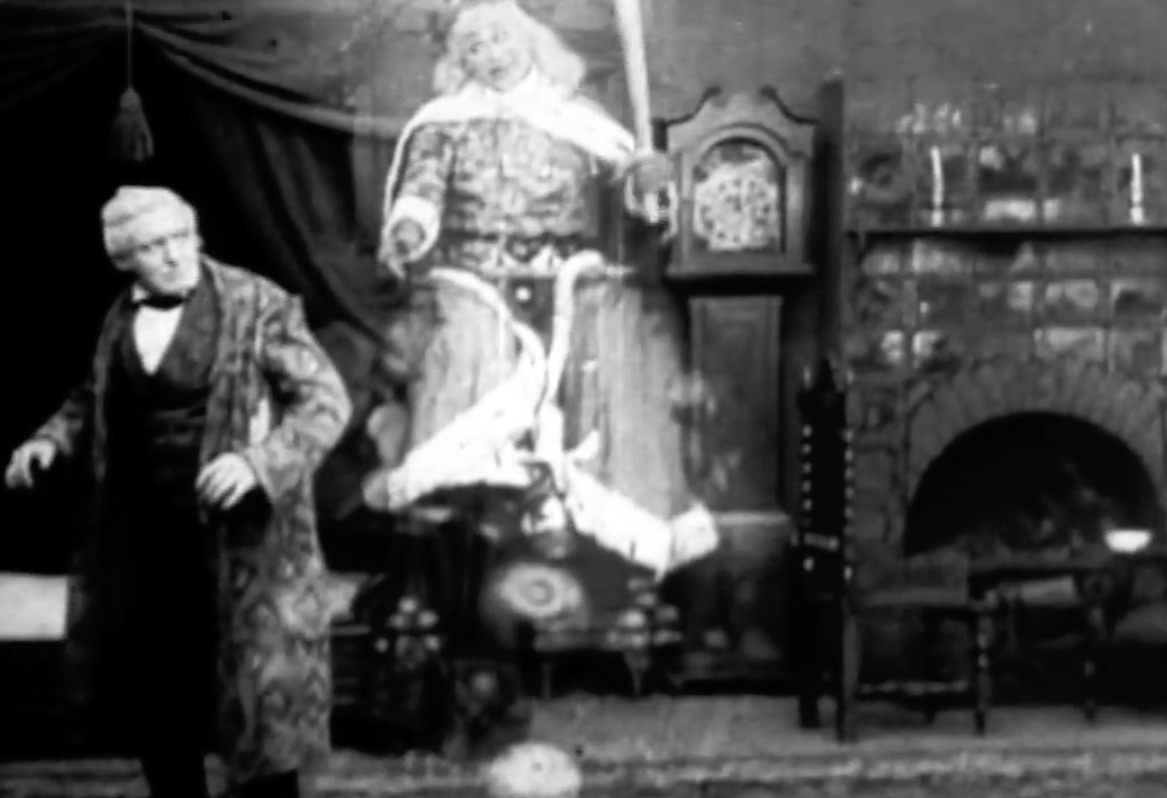
Thomas Edison's short, silent film has the same Spirit of Christmas showing Scrooge scenes from his past, present, and future, so there's no new ghost to meet this year. We do get a little interlude between visions though, first with a title card that tells us we're transitioning to "Visions of the Present" and specifically, "what the miser's wealth could do." But we also see Scrooge alone for a few seconds and apparently happy to be that way. He looks around the room and sees no ghost and I think I detect a smile. He pumps his fist as if in triumph and starts to get undressed and ready for bed. But before he even gets his robe off, the Spirit is back.

The Spirit brings no decorations or food and since he's the same ghost for all three time periods, he contains elements of at least the first two. He has the long white hair and clean shaven face of the first Spirit, but the holly crown and big torch (not horn-shaped) of the second. He's not giant, but his seat is elevated like he's sitting on a piece of furniture, so he does loom over Scrooge that way. 

It's a black-and-white production so there's no way to tell what color his robes are, but they're just vaguely regal and medieval and not like what Dickens described at all. He's wearing a fancy tunic and we don't get a good look at his feet (at least, not in my fuzzy print). I can't pick out a sword either, but it could be under the Spirit's royal cape.

Scrooge looks disappointed and impatient that this isn't over yet, so that's consistent with how he's been all along. He's shown emotion at the scenes from the past, but there's no hint yet that he's learning anything from them. He doesn't say anything to the Spirit, nor does the Spirit invite Scrooge to touch his robe. The Spirit is just going to show Scrooge some scenes in his room, whether Scrooge likes it or not.

Sunday, December 13, 2020

“Another Idol Has Displaced Me” | Mark McDermott (1910)

Thomas Edison's silent film puts this scene in with other "incidents of [Scrooge's] youth and early manhood" that it doesn't spend any time explaining or even providing context for. I'm pretty sure that Belle (unnamed in the film) is the same character that Scrooge kissed in the party vision, but it doesn't make much difference either way. 

There are no intertitle cards to explain even the broadest strokes of why the couple is breaking up, much less any specific details about mourning or something that Scrooge has done. Belle is wearing a darkly colored shaw, but that's not enough to suggest that she's a recent orphan.

Old Scrooge was dancing and enjoying the party scene, but after some unheard (by us) words from the Spirit, Scrooge is already depressed and not looking forward to whatever's coming next. He shakes his fist a little in defiance and tries to turn his back on the next scene, but the Ghost insists that he watch.

Belle and Young Scrooge appear just as she's trying to hand him something small, presumably a ring. He tries to refuse it by standing rigid and facing the other direction, but she slips it into his hand and slinks away. He looks at it and turns to reach out to her, but she's already gone. He puts the ring into a coat pocket and pretends not to be bothered, then he too fades from Old Scrooge's view.

Belle looked upset during the vision, so combined with Young Scrooge's haughty posture, it's clear that the break-up is his fault even though she's the one instigating and insisting on it. Like everything else in these Christmas Past incidents, it's a fair representation of what happens in the book, but I hate to think that this was ever anyone's first exposure to the story and their trying to figure out what's going on.

The scene ends with Old Scrooge being even more disturbed and angry as the Spirit raises it's arm to announce the next vision. In this version, there's only one Spirit of Christmas, showing Scrooge images from the Past, Present, and Future. Scrooge doesn't even get to go back to bed before the next section starts up. We just get a new intertitle card specifying that Scrooge is now going to see "visions of the present."

Saturday, December 14, 2019

“Why, It’s Old Fezziwig!” | Mark McDermott (1910)


In keeping with its limited budget and just general shortness (the whole film is less than 14 minutes long), Thomas Edison's silent Christmas Carol hits this scene quickly and all in Scrooge's room. The Spirit of Christmas (one ghost for all three time periods) simply calls up vignettes for Scrooge to look at. After the confusing (if you don't already know the story) schoolroom scene, Scrooge is despondent. But he perks back up again when the Spirit shows him visions of people getting ready for and then having a party.

Old Scrooge bounces and claps his hands throughout, but like the previous scene, there are no intertitles to explain what's going on. There's definitely one man supervising and moderating the activities, so those of us familiar with the tale know this is Fezziwig. He's a plump, jolly fellow, but he wears no wig of any type. And though there's a tall desk and a stool in the room, Fezziwig never sits at it.

Two young men do the cleaning up. One is shown more prominently than the other, sweeping the floor. This must be Young Scrooge. The other fellow (I almost said "unnamed" fellow, but they're both unnamed) is probably Dick. But without any dialogue, he's just another employee. No hint at a special attachment.

The young men are barely out of the way when the guests arrive. There are men and women of various ages, but of course we don't know if or how Fezziwig is related to any of them. A fiddler comes in and hops up on the desk and the party begins. The fellow who was probably Young Scrooge talks to a couple of women at the party, but partners up with the second one for the lone dance we get to see. As he and his partner follow the others offscreen, Young Scrooge gives her a quick kiss. So she could be Belle, though it's hard to tell in my print of the movie if she's the same woman who's in the next scene. I can't even 100% tell if it's the same actor playing Young Scrooge. It could even be Marc McDermott playing both Old and Young Scrooge. He was in his 30s when the film was made, so that would make sense. He's the only actor credited as playing Scrooge in the film.

So let's say that is Belle with Scrooge. Even though it's not what Dickens wrote, I feel like that's a pretty solid bet. The production doesn't seem like it has the scope to have two different characters in a relationship with Scrooge. The question then is: what's the point?

The last intertitle we got said that these were "incidents of [Scrooge's] youth and early manhood." There's not even a judgment about whether they're positive incidents or negative. The schoolhouse scene reminded him of his love for his sister and seeing her again made him first happy and then mournful, like he was in grief. He's happy all the way through the Fezziwig scene. So if nothing else, the Ghost is at least getting some emotion from Scrooge, which is at least progress. So far, Scrooge has mostly rejected the spirits' help and acted like their appearance was an inconvenience. Even at a very basic, broad level, we can tell that Scrooge has become engaged in what's going on. He's being reminded of past connections with other people.

My question about the next scene is what lesson Scrooge will take from it. Depending on how well the film communicates Scrooge and Belle's breakup, Scrooge could realize that his lack of current connection is all his fault. But if the reason for the breakup is unclear (meaning that Belle could possibly have instigated it through no fault of Scrooge's), then Scrooge could conceivably be justified in withdrawing further from other people. But that's next time. We'll see how it goes then.
Thursday, December 13, 2018

“I Was a Boy Here!” | Mark McDermott (1910)


In keeping with its limited budget and just general shortness (the whole film is less than 14 minutes long), Thomas Edison's Christmas Carol hits this scene quickly and all in Scrooge's room. The Spirit of Christmas (one ghost for all three time periods) simply calls up vignettes for Scrooge to look at.

The relevant one to this year's scene has Young Scrooge sitting dejectedly at a desk as a younger girl sneaks up behind him to cover his eyes. He stands up and turns around, excited to see her, then kisses her on the cheek. They pantomime her inviting him to leave the room with her and he's unbelieving at first. She convinces him though and they dance around together briefly before she playfully pushes him out of the room and follows him. I can only imagine how this would read to someone unfamiliar with the story. You really have to know what's going on ahead of time, because the film explains nothing.

Old Scrooge has mostly rejected the ghosts' help to this point. He's just wanted the whole thing to be over. But watching his younger self and (Dickens readers know) sister, he's affected. He puts his hands on his heart and then holds them out towards Fan as if he wants to embrace her. Not being able to, he balls his fists in frustration and pouts, going back to not looking at the ghost or engaging with it. The Spirit knows that it's on the right track though. It got through to Scrooge briefly, so it calls forth another scene...

Saturday, December 16, 2017

“Your Reclamation, Then” | Mark McDermott (1910)


Index of other entries in The Christmas Carol Project

Thomas Edison's Christmas Carol is only hitting the highlights, so it goes straight from Marley's disappearing to the next Spirit's showing up, right there in Scrooge's parlor. There's no going to bed, much less a countdown to 1:00. In fact, Marley never even mentioned that there would be another ghost.

I use the singular there, because that's what we get in this version. A title card announces that the new figure is "the Spirit of Christmas." Its first job is to help Scrooge recall "incidents of his youth and early manhood," but it's going to be responsible for ushering Scrooge through the Present and Yet to Come, too. For that reason, it's almost not worth comparing its appearance to Dickens' Spirit of Christmas Past, but it does pull the long white hair from there. In most other ways, it resembles the Spirit of Christmas Present.

In addition to saving money on actors, Edison also saved money on sets by having all of Scrooge's visions take place in his room. We'll get into those next year, but that means for this year that there's no hand on Scrooge's heart in order to uplift him for a journey.

Scrooge's reaction seems to be denial. That's kind of what he was doing with Marley, too: refusing to look at him and just generally wishing the whole thing would be over.

Tuesday, December 13, 2016

“More of Gravy than of Grave” | Mark McDermott (1910)


Index of other entries in The Christmas Carol Project

Thomas Edison's Christmas Carol goes straight from Scrooge still in the office to his front door. A title card announces that we'll be seeing "the ghostly face of his former partner, Marley." This is the first mention of Marley in the movie and we really haven't seen Scrooge be anything more than justifiably cranky, so this could be rough to understand what's going on. An earlier title card described Scrooge as a "hard-fisted miser," but we haven't actually seen him do anything to justify that label.

Marley's face superimposes over the knocker twice. Scrooge "humbugs" it the first time, but looks more worried after the second. He still manages another "humbug" though. He ain't no fool.

As Scrooge goes inside, another title card tells us, "The ghost of Marley, who was like unto Scrooge, warns him of his punishment hereafter unless he becomes a different man." So we're back to the "hard-fisted miser" description, because otherwise it's unclear what Scrooge needs to change.

Cut to Scrooge sitting next to a fireplace as a transparent Marley enters. Scrooge covers his eyes, disbelieving, but Marley insists that he's real. This is all done through pantomime; there are no title cards in this scene. Marley keeps motioning to himself; Scrooge keeps turning away or putting his hand through Marley to test the ghost's existence. This goes on for a half-minute until Marley loses patience, stands up, gestures, and disappears. He's replaced by another figure.

So Marley comes to warn Scrooge of punishment for vague crimes, but mostly they just argue about Marley's existence until Marley brings in a ringer. The movie doesn't reveal the punishment or what Scrooge needs to do to escape it. Maybe this new figure will explain...

Monday, December 15, 2014

“If Quite Convenient, Sir" | Mark McDermott (1910)


Index of other entries in The Christmas Carol Project

Edison's Christmas Carol is only ten minutes long, so it's super bare-boned. By the time Cratchit leaves the office for the night, we're only two minutes into the movie. The charitable solicitors and Fred all breezed in and out quickly without even intertitle cards for dialogue. As I observed the last couple of years, Scrooge's visitors are all so obnoxiously boisterous that it's hard to blame him for being cranky with them. You really have to know the story already to get what's actually going on.

But I'm never satisfied with that as an answer. The fun of this project for me is to read into what's actually in the adaptation, not what the adaptors expect me to fill in. So as far as I'm concerned, Mark McDermott's Scrooge is grouchy, but that's about it.

He fussed at Cratchit at the beginning of the story and he fusses at him again when Cratchit leaves. But that could be because of bad timing. Scrooge is still shaking his cane out the window at his departing nephew (and his nephew's loud, disruptive friends) when Cratchit abruptly gets up and starts putting on his scarf to go home. Scrooge turns his displeasure on the clerk who points to the clock. There are still no intertitle cards for dialogue, so we get no conflict over Cratchit's getting the holiday off. Instead, it's purely an argument about Cratchit's departure time and Cratchit comes off looking like a clock-watcher and maybe a little bit lazy.

Scrooge lets Cratchit go though and returns to his desk to get some more work done. So far, it's hard to see the problem with this Scrooge. As far as I can tell, there's nothing wrong with him that wouldn't be fixed by a quiet evening at home, but I don't think he's gonna get one.

Tuesday, December 03, 2013

'You Wish to Be Anonymous?' | Mark McDermott (1910)


Thomas Edison's 1910 adaptation of A Christmas Carol is one of those that has the solicitors visit Scrooge before his nephew. It's a quick scene without even any intertitles except for the one that sets it up: "The day before Christmas. Scrooge, a hard fisted miser, receives an appeal from the Charity Relief Committee."

There are three committee-members in this version and they bluster in, shake snow onto his floor, and wave a donation ledger in Scrooge's face as he tries to work. He quickly stands and shows them the door. This is immediately followed by the nephew's entrance and - as you may remember - he also has an entourage.

The effect of these two scenes is counter-productive to establishing Scrooge as a miserable person. Except for the intertitle calling him a "hard fisted miser," he could be anybody having a bad day and suffering constant interruptions to his work. I would likely be cranky too in his position and he seems justified in throwing out the bad-mannered Committee. We don't even know why Scrooge was fussing at Cratchit when he walked in, so even that could be deserved.

Tuesday, November 27, 2012

'Merry Christmas, Uncle!' | Mark McDermott (1910)


For some reason, Thomas Edison's silent film puts Scrooge's nephew after the visit from the Charity Relief Committee. It's not the only version to do that, so there must be a reason for it, but I sure can't figure out what it is.

After Scrooge kicks the Committee out of his office, a title card tells us that "His nephew calls to wish him a Merry Christmas." By the time we cut back to the action, the nephew's already halfway through the door. Scrooge doesn't seem to see him though (or is just ignoring him) and continues working. He doesn't look up or turn around until his nephew's standing right over him, but his attention could also have been gotten by the large, boisterous group of people coming through the door next. The nephew, it seems, has brought friends (two women and a gentleman). And they're in a great mood.

The nephew tries a couple of times to shake Scrooge's hand, but Scrooge ignores it, seeming much more concerned about getting this rabble out of his place of business. He shows them out and then bows towards his nephew to indicate that he can follow them. The nephew tries once more to shake Scrooge's hand, but this time Scrooge outright refuses. Scrooge closes the door behind his nephew and takes the time to shake a cane at the party through his window. Scrooge's nephew seems jolly throughout most of the scene, but he's somewhat deflated by his uncle's rebuffing as he leaves.

I'm not sure what the deal is with his bringing an entourage. I had a nice little theory about his bringing friends in hope that Scrooge will see that he's honestly wanted by the entire group for Christmas dinner. That falls apart though because there is no actual dinner invitation in this version. As presented, the nephew's just barging in on Scrooge's workplace with his rowdy friends and Scrooge is perfectly justified in throwing them all out. This is supported by the end of the film when Scrooge goes to visit his nephew. We'll see the reason for the visit when we get to that scene, but there's no dinner or party involved.

Which boils the current scene down to Scrooge doesn't like his nephew and his rowdy friends. Marry that up with Scrooge's fussing at his clerk and refusing to help the Charity Relief Committee and you've got a clear picture that Scrooge isn't easy to get along with, if not exactly a reason why that is. Since we don't get to hear any of the dialogue in this scene, we don't learn anything new about Scrooge's relationships with his clerk or nephew.

Friday, December 02, 2011

Old Sinner: Mark McDermott (1910)


I love silent films for a few reasons, but one of them is that there’s such economy to the way the stories have to be told. For that reason, adaptations also tend to be really faithful to their source material. They don’t add a lot of extra stuff.

The first-ever adaptation of Christmas Carol opens with the intertitle: “The day before Christmas. Scrooge, a hard fisted miser, receives an appeal from the Charity Relief Committee.” The CRC doesn’t figure into this post, so we’ll leave it alone until later. In this version, all you really need to know about Scrooge is that he’s “a hard fisted miser.” After the intertitle, we see Scrooge enter his office and yell at his as-yet-unnamed clerk, adding to the unpleasant image.

Mark McDermott is a tall man and his Scrooge is an imposing character. That’s really all we can tell about him at this point. His height and posture doesn't mesh well with the image I form from Dickens' description of the "squeezing, wrenching, grasping, clutching, covetous old sinner," but I realize that Dickens is talking about character traits, not physical ones. The picture in my head is influenced as much by Gollum as anything Dickens wrote, but it's still difficult to look at McDermott and come up with "wrenching" and "grasping" as adjectives. I notice that the intertitle changes Dickens' "tight-fisted" to "hard fisted;" a more appropriate description for McDermott's presence.

Anyone familiar with the story can speculate that he’s fussing about coal-use, but it’s not clear yet in this film. All the movie lets us know is that he’s a “miser” and that he’s cranky. There's nothing in the visuals yet to suggest Christmas; just the intertitle letting us know what day it is. We also get nothing about Scrooge's business or Marley. Because of the film's short length, it's going to have to be economical about how it shares that information, wrapping it into other character interactions.

LinkWithin

Related Posts with Thumbnails