Showing posts with label carrey christmas carol. Show all posts

Wednesday, December 15, 2021

“Come In! And Know Me Better, Man!" | Jim Carrey (2009)

After his apocryphal fall from orbit at the end of Christmas Past's visit, Robert Zemeckis' Scrooge is still flat on the floor when the clock tolls One and he hears a distant chuckling that grows louder as the dark bedroom grows brighter. Scrooge looks to where the light is coming from and sees it twinkling and spilling around the edges of the parlor door. 

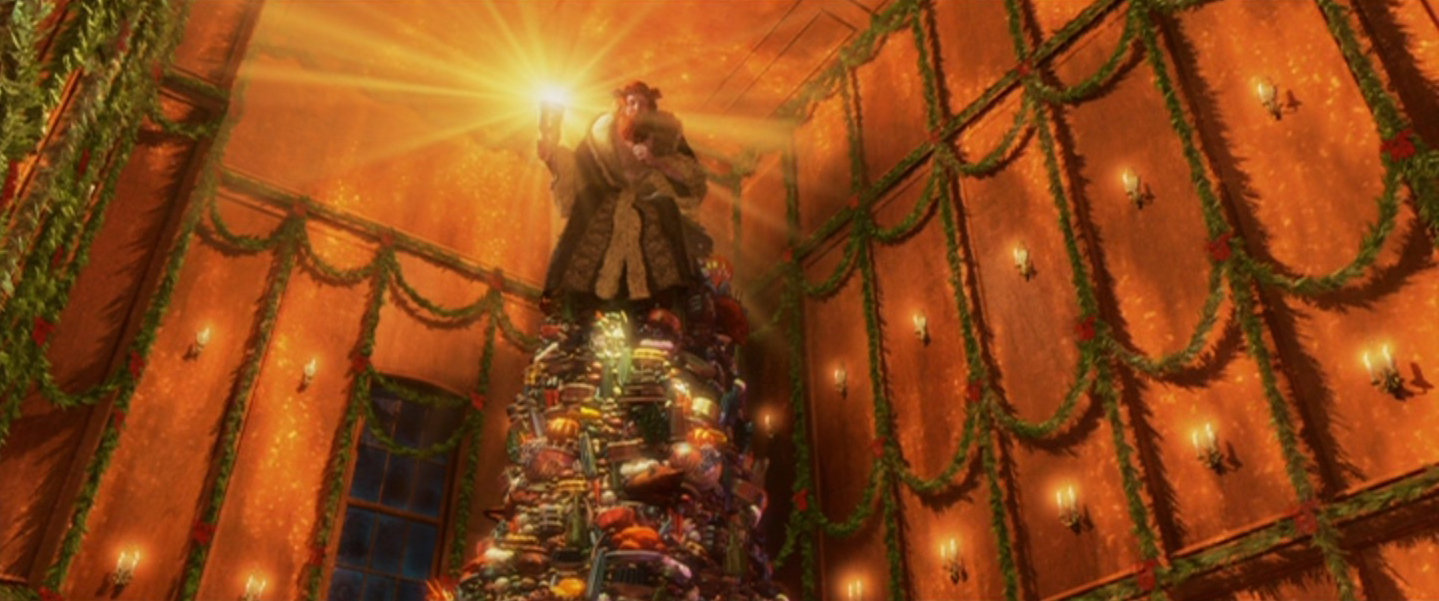
Once Scrooge has gotten to his feet, the door flies open on its own to reveal a golden lit room bountifully decorated with candles and garland. In addition to being more festive, the room is also much bigger and taller than it was when we last saw it. A variety of chiming clocks fill the air with sweet sounds as the Ghost's laugh gets still louder and more boisterous. And as the camera pans across, it finally reveals a mountain of food with the Ghost perched on top of it. 

The Ghost is so high above Scrooge that it's tough to get a sense of scale, but he certainly gives the impression of being enormous, both physically and spiritually. His horn-shaped torch is decorative, but doesn't have the usual, ridged texture of a cornucopia. It works though and the light from it is extremely bright. He's bare chested and has long, brown hair, though once again his holly crown has no icicles.

His green robe is also ornately decorated with embroidery, but the fur trim is light brown instead of white. And it's so long that we never see his feet and whether or not he's wearing any shoes. I peeked ahead and we don't even see his feet when he pulls back the robe to reveal Ignorance and Want. He has another robe underneath. Modest about his toes, this Ghost.

He's wearing the empty sheath and Scrooge even comments on it. Like the rest of this Ghost's clothing and accessories, there's a lot of detail on it and it looks quite old, but it's not rusted. When Scrooge points out that it's empty, the Ghost looks at it and seems surprised and shrugs. "Peace on Earth! Good will toward men!" I like that the movie pauses to explain that detail. It's not necessary to understanding what's going on, but if you're going to include the scabbard, as most versions do, you might as well acknowledge its symbolism.

I also like that when he talks about having 1800 older brothers, he adds, "Eighteen hundred and forty-two, to be exact." It's like we're getting helpful little annotations.

That said, though, I don't love this version of Christmas Present. Like the other Christmas Ghosts in the movie, it's also played by Jim Carrey, which is a gimmick. There's no reason for it in the story and he's not the best choice for the role. He looks like Jim Carrey in a wig and fake beard, his laugh is manic, and his half-hearted Scot accent isn't contributing anything.

Carrey's Scrooge continues to be strong though. He continues to be humble and respectful, even though he doesn't explicitly say anything about the lesson he learned from the previous ghost. "Spirit," he simply says, "Conduct me where you will."

So the Spirit laughs again and lowers the belt of his robe to the floor so that Scrooge can grab it. When Scrooge does, the belt lights up, the mountain of food begins to disappear, and the room changes in a way that's unique to this version. We'll save that to talk about next year though.

Saturday, December 12, 2020

“Another Idol Has Displaced Me” | Jim Carrey (2009)

Like in Mickey's Christmas Carol, Robert Zemeckis sets this scene at Scrooge's office. Which, I think, it probably the best place for it. I like the outdoor versions just from an aesthetic standpoint, but what better place to talk about Scrooge's changing priorities than in the place that symbolizes his new idol?

Belle is wearing a black dress and bonnet and even mentions during the coming conversation that she's been left penniless by the death of her parents (as Dickens intended, but didn't specify). Robin Wright plays Belle (she was also Fan in the schoolhouse scene) and she and Carrey both do phenomenal acting work here. The blocking is exceptional too and helps bring this conversation to powerful life. Young Scrooge appears to be terrified of poverty, giving a lot of weight to Belle's observation that he fears the world too much. He doesn't actually want to let her go, but he feels trapped between his still real love for her and his powerful anxiety about financial want. I believe that the battle between love and fear is the great human struggle and I love that it's demonstrated so clearly and powerfully in Scrooge with this version.

When Belle claims that Scrooge was another man when they were first engaged, clearly preferring that one to his current self, he gets angry. "I was a boy!" he shouts, and slams his fists on his desk, startling not just Belle, but even the older version of himself watching on.

Belle takes a few seconds before saying resignedly, "I release you, Ebenezer." She gets up to go.

But Young Scrooge isn't done. He rushes to her grabs her roughly by the arm. "Have I ever sought release?" 

The conversation continues on in the usual way, but filled with the pain of both participants. He eventually lets go of her arm and by the end of their talk he's standing apart from her, not looking at her. "I release you," she says again and her wishes for his happiness in the future are heartfelt.

Old Scrooge is still humble and respectful, as he was with Marley and the previous Christmas Past scenes. When he demands to be removed from the memory, it's a request, not an order. He phrases it like an order, just as Dickens wrote it, but he's clearly uncomfortable and not even looking at the Spirit.

He does look at the Ghost when it insists that these memories are the way they are because of Scrooge, but even then Scrooge looks frightened. He freaks out even more when the Spirit's face starts to morph into various other faces from Scrooge's past. The music turns ominous during this part, too. Scrooge wants to be let go, but the Spirit only forces him to relive everything yet again in the faces of these people.

Scrooge's mouth is quivering when he utters his final, "Leave me! Take me back!" He grabs the extinguisher cap in desperation, shouting, "Haunt me no longer!" as he forces it down on the Ghost.

There's resistance from the Ghost and the bright light even flares into flame at one point, but Scrooge finally manages, with a great deal of effort, to get the cone all the way to the floor. There's no light spilling out around the bottom edge, but Zemeckis will communicate the Ghost's final victory another way.

Obviously we're not going to see Belle's life after Scrooge in this scene, but what Zemeckis replaces it with is unfortunate. As I've mentioned before, my big complaint about this film is that Zemeckis tends to go overboard with the lack of limitations that animation has allowed him. Fezziwig's gravity-defying dance in the previous scene, for example. And in this scene, Scrooge has the extinguisher cap all the way to the ground and appears to have overcome the Ghost when the cap explodes and shoots into the air like a rocket, with Scrooge still clinging to it.

It takes him high into the atmosphere before sputtering out and then disappearing in Scrooge's clutches, leaving him alone above the clouds to plummet to Earth. There's no reason for any of this except to further terrify and torture Scrooge. But instead of the psychological agony of having to confront his past, this is easy, physical terror for it's own sake. It has nothing to do with redeeming Scrooge that I can tell; merely with punishing him. It feels extreme and unnecessary, both on the part of the Ghost and of Zemeckis himself.

Scrooge lands in his own room, not with the deadly splat that physics would demand if he actually had fallen from the upper atmosphere, but it's still hard enough to look like it hurt. And when the camera pulls back, it's apparent that Scrooge has fallen out of bed. 

Friday, December 13, 2019

“Why, It’s Old Fezziwig!” | Jim Carrey (2009)


Robert Zemeckis continues to play a lot with the animated format. Sometimes that's good and sometimes... not so much. We see both in this scene.

The transition from the previous scene is great. The Ghost takes Scrooge's hand in the schoolroom and they zoom down the long room, through a large opening that was a painting of London a minute ago, and into the actual London. They soar over the icy Thames, under bridges, then to shore and through gaslit streets until they arrive at Fezziwig's warehouse in a quiet, industrial part of town.

Scrooge is overjoyed to see it again. He gives a deep chuckle as he recalls that he was apprenticed there. Jim Carrey's Scrooge is well on his way to transforming. He's been deeply affected by the ghosts so far, going from frightened to humbled and now - even as he gets used to this one - still respectful.

The scene changes around them and they're inside the warehouse. Fezziwig (played by Bob Hoskins) is jolly and fat, wears a powdered wig, and sits atop a ridiculously high ladder at a ridiculously high desk. I say, "ridiculous," but that's a good thing. Fezziwig should be ridiculous.

He calls Young Scrooge and Dick Wilkins by name, leading Old Scrooge to reminisce about Dick's attachment to him. There's nothing but fondness and happy memories when he talks about Dick. There's nothing about "poor Dick" and Scrooge clearly reciprocates the attachment. As he's talking, his young self and Dick are laughing with Fezziwig and trading playful punches with each other.

Fezziwig orders the shop closed and we see Young Scrooge and Dick cheerfully clear aside tables (passing through the ethereal Old Scrooge with one of them). The scene transitions to the party before they get to any shutters, though.

The fiddler's on the desk at the party and I like the sound of stomping feet to add percussion to the dance music. Unnamed guests (no explicit mention of any of their relationships to Fezziwig, either) twirl on the edges of the dance floor, but the center is reserved for Fezziwig and his wife. This is where I think Zemeckis goes overboard on the animation. Earlier he had Fezziwig dismount from his desk with an acrobatic flourish that seems unlikely for a man in Fezziwig's shape, but it was fairly easy to pass that by. Now though, the Fezziwigs positively defy gravity with the hang times of their jumps. It's a bit much even though it's all for laughs and ultimately punctuated by the fiddler falling off his perch and into the punch bowl.

Fezziwig boisterously announces the next dance: "Sir Roger de Coverley." Young Scrooge is as pleased as everyone else by it. Old Scrooge looks crestfallen. He knows what's about to happen. Belle is definitely in this scene.

She turns up as Scrooge's dance partner in the "Sir Roger" and frankly it's hard to tell if this is their first meeting or not. She's smiling warmly at him, but that could be polite dance etiquette or genuine fondness. He's captivated by her, but that could either be Love at First Sight or maybe he's just that smitten every time he's around her. I think it's probably their first meeting as that better explains why Old Scrooge immediately recognized the moment and had a strong reaction to it before it even happened.

Belle and Young Scrooge don't talk at all in this scene. It's all about beautiful, swelling strings and soaring emotions and time standing still while they're in each other's company. It really sells that Scrooge is falling in love. Belle is too elegant to reciprocate in any obvious way, which is too bad. It succeeds at developing Scrooge, but misses the opportunity to make Belle more than just a plot device. We'll see if the next scene does better.

Old Scrooge and the Ghost don't talk at all during this point. Scrooge just looks on sadly at the dancers and then the room grows dark and changes to Scrooge's office for the next scene. That means there's no attack on Fezziwig by the ghost or defense of him by Scrooge. And no connecting Fezziwig's treatment of his employees with Scrooge's treatment of Bob Cratchit. Even though Zemeckis included more of Fezziwig than Rankin-Bass did, he is - like they were - more concerned with introducing Belle and setting up the doomed romance.

Wednesday, December 12, 2018

“I Was a Boy Here!” | Jim Carrey (2009)


Robert Zemeckis plays a lot in this animated format, unbound by the limitations of filming live action. Sometimes that's to a fault, but his instincts are pretty good in this scene. The Ghost of Christmas Past never walks anywhere with Scrooge when he can fly the two of them there at a crazy and exciting speed. So we get a transition scene of them zooming out of Scrooge's bedroom and into the snowy countryside. They continue zooming through trees and over fields until they reach a small, country town with a church and a bridge and lots of cute houses. It's very picturesque.

Jim Carrey's Scrooge has already been deeply affected by the ghosts so far. He's frightened and humbled by them, willing to listen to what they have to say. He's visibly moved by the sight of his hometown, smiling and speaking breathlessly about it. The Spirit notices that Scrooge is trembling and thinks that it spots a tear, but Scrooge claims that it's "something in my eye." (I doubt very many adaptations will stick with the lame pimple explanation that Dickens had him use.)

I'm sure I've mentioned before that Carrey is a very good Scrooge. He's acting his heart out in the role and it's touching to see Scrooge so emotional about being home again. He's truly excited by the town and his schoolmates whom he sees riding out of it on horseback and in a wagon. He doesn't call them by name, but says that he knows "every one of them." Their wagon is plastered with a big Merry Christmas banner and though Scrooge doesn't call it out as a reason for joy, he's clearly not humbugging it either.

The Spirit zooms again with Scrooge, this time through the town and to a large, brick schoolhouse on the other side. Scrooge recognizes it with less excitement. His face grows sad and pained as he looks at it, and the Spirit puts those emotions into words, talking about the solitary child neglected by his friends.

They fly again, through the front door, up a grand staircase, and down a hall to Scrooge's classroom. The building doesn't look especially run down, but it is bare and lonely looking. Young Scrooge sits alone in the classroom, singing "O Come, All Ye Faithful" to himself in Latin. He's getting a good education clearly and he's not yet given up on the holiday. He's trying to make himself merry as much as possible, but his voice is sad. As the camera swings around to his face, he gives up the song partway through and frowns in misery. "Poor boy," says Old Scrooge. "Poor, poor boy." And I believe it. There's not even any consolation in fictitious friends, either. The movie skips that part, but I feel like its for a reason: taking away even that little bit of comfort from Young Scrooge.

The Spirit invites Scrooge to see another Christmas and the room darkens and decays around them. The Boy Scrooge fades away as a Young Man Scrooge fades in at the other end of the long room, walking the aisle despairingly as Dickens wrote. He's tearing pages and throwing them on the floor, but the movie doesn't reveal what that's about. They're loose pages, not a book, so maybe it's a letter? Or maybe it's just paper. Something for Scrooge to do instead of sit and feel horrible.

Fan interrupts his bad mood with all the excitement of a young girl. She's maybe nine or ten, much younger than him. Her dialogue is right from Dickens with no embellishment, so we learn that Scrooge's dad does bear some kind of grudge against Scrooge, but we get no details about why that might be.

Old Scrooge is heartbroken by the scene. Memories of his sister rush in and he clearly loves her as he talks about her large heart. He's thoughtful as the Spirit mentions Fred, but there's no time to dwell on Scrooge's nephew. The Spirit takes Scrooge's hand again and they zoom down the long room, through a large opening that was probably a blackboard a minute ago, and into London.

Friday, December 15, 2017

“Your Reclamation, Then” | Jim Carrey (2009)


Robert Zemeckis' Christmas Carol skips straight from Scrooge's hiding in bed after Marley's visit to one o'clock. Scrooge is awake and very frightened, but there's no telling if he got any sleep before that or has just been awake the whole time. If he's been awake though, I doubt he's been fretting over the passage of time. He is clearly super freaked out.

As soon as the local church bell chimes one, Scrooge's bed curtains are pulled aside by themselves and a strong, focused light (like a miniature spotlight) turns on. It's pointing straight up at first, but then moves around the room to shine briefly in Scrooge's face before becoming a vertical shaft of light again. The Spirit has been floating near the floor and out of Scrooge's line of sight from his place in the bed. As it raises up, the shaft of light becomes less intense and settles into the flickering flame that makes up the Spirit's head.

The Spirit carries the cap and holly branch (at first, anyway; it'll lose the holly branch pretty quick). And it's a small-sized ghost. It kind of does the old-young thing, but in a different way from Dickens. Instead of human features, it's simply a flame with a face. And its body even suggests a candlestick.

Zemeckis has Jim Carrey playing the Spirit, which isn't a choice I like, but I do see where they're going with it. If the Spirit is the ghost of Scrooge's Christmases Past, then why not make it look like Scrooge? The problem is that I keep imagining Jim Carrey against a green screen, bobbing and jerking his head around to resemble the flickering of a candle flame. And that yanks me right out of the story. I had the same reactions to seeing Colin Firth and Gary Oldman too accurately represented in their CG characters. Pretty much all my feelings about this version of the Spirit are like that. Every choice is intentional and the goal is always to represent Dickens, but the overall effect is creepy and off-putting (only not just in the intended way).

Because the Spirit is so bizarre, Scrooge continues to be frightened. He does ask the Spirit to put its cap on, but he asks very timidly. And the Spirit is so oppressively bright that I understand why Scrooge musters the courage to make his request. (As the Spirit answers him, I notice that it's got an Irish accent for some reason. That would make some sense if Scrooge was himself Irish, but I don't recall that being revealed as true anywhere else in this version. It's probably just Carrey adding one layer too many onto this performance.) Reprimanded by the Spirit for the question, Scrooge is immediately submissive and apologetic.

The Spirit just kind of hovers there, being weird, and Scrooge settles down a little, becoming less frightened and more interested in the apparition. "O Come, All Ye Faithful" plays sweetly in the soundtrack as the Spirit reveals what it is. "Rise," it says, "and walk with me." The line is straight out of Dickens, but something about the way that the Spirit grabs Scrooge's hand and gently pulls him out of bed reminds me of the stories where Jesus Christ offered disabled people the chance to "rise and walk." In other words, the Spirit is already a symbol of healing.

Sticking with the religious theme, the song swells and becomes "Ave Maria" as the Spirit pulls Scrooge towards the window. As they walk, the Spirit is able to change the direction of the flame on its head so that the spotlight points directly in front of him. So that's how it was shining in Scrooge's face earlier.

Scrooge's fear gets the better of him and he grabs his bed curtain to keep from being ushered outside. He explains that he's a mortal and liable to fall. The Spirit touches Scrooge on the heart (leaving its cap floating in midair to do it) and Scrooge looks rapturous as light enters his body and his feet leave the floor. But his ecstasy turns to nervousness when the Spirit shoots them through the room, out the window, and into snowy countryside.

Monday, December 12, 2016

“More of Gravy than of Grave” | Jim Carrey (2009)


Index of other entries in The Christmas Carol Project

Robert Zemeckis' Christmas Carol really plays up the ghost story angle for this scene. It's the only feature-length animated version I'm covering and the extra run time gives it room to draw out the suspense in a powerful way.

I like how it handles the knocker-to-Marley transition too, because we don't actually get to see it. Scrooge drops his keys at the front door and bends down to get them. When he straightens back up, Marley's face is waiting for him, hair blowing in his own, personal wind. It's a cool scare, but I also like how dropping the keys reveals something about Scrooge.

He swears when they fall, then mutters to himself about how everything always happens to him. This Scrooge doesn't play the victim where Christmas is concerned, but he still sees himself as a one. Not just about Christmas, but about everything in his life. Things have not gone the way he wanted or thinks he deserves. As I said in the Fred scene, Scrooge made a horrible decision earlier and lost the love of his life. The Ghost of Christmas Past will reveal that this Scrooge is terrified of the world and seeks desperately to control it. That's why he's so rotten to everyone and why he's so miserable. His life has become a terrible self-fulfilling prophecy: misery begets more misery which begets more misery still.

His fright at seeing Marley's face causes him to stumble and slip on the ice, falling painfully on the doorstep. When he gets up again - in an even worse mood - the knocker is back to normal. He decides that he must have imagined it.

Inside, he lights a candle and heads upstairs. The staircase is enormous, both wide and long. There's no ghostly hearse, but the immensity of the hall and the failure of Scrooge's little candle to illuminate it makes it just as scary.  Anything could be hiding in the shadows and corners.

Cut to Scrooge's room (his fireplace is in the bedroom, not a separate sitting room) where he's quietly eating his gruel. The stirring of his pot and the popping of the fire are the only sounds and they start to play tricks on him. As does his own, flickering shadow cast by the fireplace on the door. Disgusted with himself, he drops the pot on his table and goes over to triple-lock the door. There's one other door that leads to a large, disused room, so Scrooge closes that one, too.

He sits back down, mumbling comfort to himself, then the camera pulls back to reveal a series of servant bells high on a wall. One of them starts to move and Scrooge notices it before it ever makes a sound. I love Carrey's face as he goes cold, seeing evidence that it's not just his imagination. The bell starts to ring softly, then the one next to it joins in and then the others and some clocks and chimes from all over the house. They go crazy for a bit and Scrooge covers his ears, lips trembling.

When the bells stop, Scrooge looks panicked, not sure what's happening to him. Immediately, there's the sound of a large door closing in some other, deep part of the house. That's followed by heavy footsteps and dragging chains. Step. Drag-clank. Step. Drag-clank. Louder and louder, closer and closer, until it stops right outside the door. The doorknob turns back and forth, testing the lock.

Scrooge is scared out of his mind, cowering in his chair, but he's able to muster enough courage to yell, "It's still all a hum--" before a ghostly blue cashbox - attached to a chain - comes flying through the door right at him. It misses his head and goes through his chair, then other boxes follow, attached to other chains. Finally, Marley emerges, transparent and with not just blowing hair, but a blowing mist that surrounds him like an aura.

As the conversation begins, Marley seems like he's not entirely present. I don't mean that he's distracted, but he doesn't make eye contact with Scrooge or even really look in his direction. It's like he's blind or maybe struggling to acclimate to the physical world and doesn't quite have his bearings yet. I quite like it. He gets more focused as the conversation progresses.

This Scrooge isn't a humorous man, so his gravy pun doesn't even come off as a joke. Carrey plays it straight, with some accusation towards Marley as if the "hallucination" is tormenting Scrooge on purpose. Which of course means that Scrooge does believe what he's seeing, but is just trying to convince himself that he doesn't.

Marley continues to be terrifying as they talk. Gary Oldman is playing Marley, but unlike his portrayal of Bob Cratchit, it's impossible to tell. Zemeckis didn't use Oldman's face as the character model this time and Oldman has disappeared into the part. All I can see is a dreadfully effective spirit who really sells the horror of what's awaiting Scrooge after death. He has no patience for Scrooge's defense of his and Marley's actions. He never removes his bandage, but when Scrooge talks about being a good man of business, Marley wails so hard that he dislocates his bottom jaw.

Unfortunately, the scene gets silly for a minute there as Marley tries to fix himself. He uses his hand to bounce his jaw so that he can continue talking. Then he gets annoyed by that and adjusts his bandage so that his bottom lip covers half his face and he can't talk anymore. This is all disgusting to Scrooge, so it doesn't lessen the effect on him, but the goofiness doesn't fit the tone of the rest of the scene.

Once Marley gets himself sorted, the conversation continues and Marley offers Scrooge the chance and hope to avoid Marley's fate. Faithful to Dickens, Scrooge is grateful until he learns that the chance and hope involve being visited by three more ghosts (on the same three-night schedule as the book).

Marley flies out the window to join the other phantoms and Zemeckis does some imaginative things with those poor souls. They're all being tortured in various ways: one is trapped in a padlock and being hit on the head with a key, another is being continuously squashed between two giant coins; yet another is tethered to a giant bag of money that he can never reach. It's all very Dante and simultaneously funny and horrifying, but it misses Dickens' point until Scrooge looks down to the street and sees the woman with the baby. Several spirits are reaching out to her impotently with one even shouting, "I wish I could help you!"

That one notices Scrooge watching and speeds towards Scrooge's window, perhaps intent on trying to help him. But Scrooge runs to his bed and the window slams shut on its own (or perhaps aided by an unseen Marley?). We're left with a very frightened Scrooge who's now more afraid of the afterlife than he is of the world around him. That's not enough to change him, because like Walter Matthau's Scrooge he doesn't know how. But I'm betting that he's willing to learn.
Tuesday, December 15, 2015

His Usual Melancholy Tavern | Jim Carrey (2009)


Index of other entries in The Christmas Carol Project

Robert Zemeckis' Christmas Carol also skips dinner. It goes straight from Cratchit's sliding adventure to Scrooge's arrival at home. I suppose it's a comparison between the joyful frivolity of the sliders (though everything looks gloomy in this movie so far) and the silent solitude of Scrooge's walk. Like in a couple of other versions we've looked at, there are no other people on the streets in Scrooge's part of town.

His house is a large mansion that stands tall and lonely, separated from the world by a large, brick wall. The ponderous, black, iron gate sounds like prison when Scrooge closes it behind himself. I don't imagine that Scrooge shares this building even with business offices. The whole point of the place is to show how cut off and isolated he is.

Sunday, December 14, 2014

“If Quite Convenient, Sir" | Jim Carrey (2009)


Index of other entries in The Christmas Carol Project

Jim Carrey's Scrooge is perhaps the most odious of them all. From his repulsive appearance to his naked disgust of all other humans, he's aggressively, intentionally offensive. Gary Oldman's Cratchit is also offensive, but in a different way. He's an idiot.

There are other simpleton Cratchits (and we'll be coming up on some of them shortly), but Oldman's has a vacant expression and an unaware grin that make him seem more House Elf than human. Which may be why Scrooge tolerates him. This Cratchit has no will of his own, so he's no challenge to Scrooge's misanthropic view of humanity. If all people were like this Cratchit, I'd hate them too.

I'm being very hard on this Cratchit, but there's potential for a very great lesson to be learned here. I don't think I'm alone in sometimes being tempted to judge the people around me. I don't do it all the time, but I question motives and intelligence more often than I should. One of the lessons that Scrooge - and I - can learn in this version is that there's more to Cratchit than first appears. Maybe he's actually as stupid as he looks, but that doesn't mean he's without value.

We get a hint of that after he and Scrooge leave for the day. Their conversation goes pretty much as Dickens wrote it, with Carrey and Oldman's performances supporting the interpretations of the characters as I've described them. They also leave the office together, though it's Scrooge who locks the door, presumably not trusting Cratchit with the responsibility. That's part commentary on his feelings about Cratchit, but it's also consistent with his feelings about everyone. In fact, this Scrooge not only locks the office door, but also shakes the locks to make sure they're sound.

Cratchit stands still for a moment and watches as Scrooge shuffles into the fog. Then the music becomes festive and Cratchit begins to giggle and shake in excitement. It's Christmas Eve and he's like a little kid. He runs around the corner, sees some boys sliding on a long patch of ice, and joins them.

That's when I realize what Oldman is doing with this performance. He's playing Cratchit as a small child. That's super creepy to look at and it still says very unflattering things about Cratchit's mental ability, but it's an interesting choice that I'm curious to see play out over the course of the film.

Saturday, December 21, 2013

'You Wish to Be Anonymous?' | Jim Carrey (2009)


Index of other entries in The Christmas Carol Project

In Robert Zemeckis' A Christmas Carol, the charitable solicitor scene has a couple of things in common with TNT's Patrick Stewart version. Instead of a pamphlet, Zemeckis has the solicitors offer Scrooge a card as credentials, but there's also a shot where Cratchit looks rather nervous at what's about to happen and sneaks away back to his little office. Gary Oldman plays this Cratchit as kind of a simpleton though, so we get an idiotic smile from him first as he approvingly listens to the solicitors.

When Scrooge corrects the gentlemen about Marley's death, he does it with a dramatic, ominous flourish. He not only wants to set them straight, he wants them to be uneasy about it. And this is before they've even mentioned why they're there. Jim Carrey's Scrooge is aggressively offensive. Stewart's Scrooge has built walls to keep people out, but Carrey's also has soldiers atop them to shoot at anyone who stops to show interest.

He calmly listens to their pitch, sliding his candle closer to look at their card, and when they finish, he responds in a careful, measured way. "Are there no prisons?" he purrs, holding the card close enough to the candle that it starts to sizzle.

The lead gentleman snatches the card away before it can burn. He's skeptical and cautious at first in how he answers Scrooge, obviously thrown off his game, but then he rallies and continues his pitch until Scrooge growls that he only wishes to be left alone. He asks the men to leave and they comply.

Overall, there's not a lot new here, but that's been the way with most of the adaptations. The solicitors generally show some hesitation when Scrooge asks about prisons and workhouses, but soldier on, thinking that they must have misunderstood him. They're simply not used to this kind of response. In addition to showing us more of Scrooge's attitude about the world, the scene highlights the contrast between his view and the rest of correct-thinking society.

In reality, Scrooge's view wasn't so different from a lot of powerful men in Victorian London, but Dickens writes as if it is. These portly - in Zemeckis' version, extremely portly - gentlemen may make merry all year round, but at least at this one time of year they think beyond themselves and consider those less fortunate. And they're used to seeing that attitude in everyone they talk to. It's not a radical kind of compassion, it's simply the baseline that any human being should be expected to possess. But Scrooge doesn't even have that.

Friday, December 21, 2012

'Merry Christmas, Uncle!' | Jim Carrey (2009)


I don't like how Fred looks exactly like Colin Firth in Disney's Christmas Carol, but I don't find much else to dislike about this version of the character. He bursts in merrily and seems genuinely excited to visit Scrooge, which is how I like Fred to act. I get tired of the Freds who see their visits as a chore, and I admire the ones who are relentless in their optimism that maybe this will be the year that Scrooge comes to dinner. Firth's is one of those Freds.

He tries to keep his spirits up, but Scrooge takes a lot out of him and ends up getting his goat a couple of times. He's horrified by the "stake of holly" comment and his big speech is impassioned and just a little bit angry. He keeps trying to smile though and I respect the hell out of him.

Cratchit comes out of his room for the speech and claps at the end, but there's nothing new to that bit. It's not particularly funny when Scrooge yells at Cratchit and threatens his job. Cratchit looks like a scolded puppy as he makes his way back to his desk.He's not really frightened for his position, but he's embarrassed and humbled.

Surprisingly, Disney's is one of the few adaptations that goes for Scrooge's full "I'll see you in hell first" as a response to Fred's dinner invitation. He gets in Fred's face as he says it too, and it kicks off a nice bit of acting by both Carrey and Firth as they discuss Fred's marriage.

Scrooge pauses before he asks why Fred got married. Some of the other versions have him whip out "why did you get married" as if it's been on his mind the entire scene. In this one, he has to think about it for a second. Or maybe he's reluctant to bring it up for some reason. I tend to think it's the latter explanation. As I'll discuss in a minute, this is a sore subject for Scrooge and not one he should be overly eager to get into.

Fred also pauses before "Because I fell in love" as if he genuinely doesn't understand the question. He's not condescending in his answer, but very sincere. He realizes that he and Scrooge are on completely different pages and he wants to use the opportunity to hopefully help his uncle see the light.

Scrooge's response is complicated and layered. Like I said last year, I have several problems with this version, but Carrey's performance isn't one of them. He sneers a little at Fred's answer, but his tone's not mocking as he repeats his nephew's words. He looks genuinely disbelieving. Not so much that Fred fell in love, but that he would actually try to use that as an excuse to Scrooge. In Scrooge's mind, love has nothing to do with anything.

I don't know if I've said this out loud before (I think I was going to save the observation for a later scene), but since this is the last film adaptation we'll look at this year, it's a good time to mention that Scrooge's disagreement about Fred's marriage comes from a very personal place. We've seen that hinted at in a couple of adaptations and this one does it too. The relationship between love and marriage isn't just an intellectual exercise for Scrooge, it's something that he made a definite decision about as a young man, and that decision affected the rest of his life.

In the better versions of this scene, there's all kinds of foreshadowing about why Scrooge reacts the way he does to Fred's marriage. At a crucial moment, Scrooge chose to follow traditional, Victorian mores about making one's fortune before getting married. Fred has made the opposite choice and adaptations like this one (and George C. Scott's and Patrick Stewart's and Alastair Sim's) emphasize how much it pains Scrooge to see his nephew so happy in his penniless marriage. It's a painful reminder that Scrooge made a horrible, horrible mistake once upon a time.

Thursday, December 22, 2011

Old Sinner: Jim Carrey (2009)


Though there’s plenty to complain about in Disney and Robert Zemeckis’ 3D, motion-capture version of A Christmas Carol, there are some things it does right, too. One of them is the opening shot of a snowy, Victorian street through a window lit with a warm candle and festively decked with greenery and red berries. It immediately puts me in the Christmas mood without so much as a carol. In classic Disney fashion, the camera pans down to the window sill to reveal Dickens’ A Christmas Carol opening to its first page. It zooms to the phrase: “Marley was dead.”

The cheerful music turns sinister as the page quickly flips to reveal a woodcut of a dead man’s face; the jaw is tied shut with a kerchief and coins cover the eyes. As the woodcut morphs into the CGI corpse, it’s apparent that this version is following a similar tactic to Patrick Stewart’s by beginning at Marley’s death.

Jim Carrey’s performance as Scrooge is another thing the film gets right. He plays several characters in the movie and doesn’t do as well with any of the others, but Scrooge’s design and Carrey’s talent help disguise him in the lead role. Like Stewart, there’s sadness in Carrey’s eyes as he pronounces his friend dead. Unfortunately, the script doesn't support him very well. Pronouncing Marley dead isn’t really Scrooge's job, but for the purposes of the story we’re supposed to know that he knows Marley’s dead, so this is them getting that communicated. It’s a clunky way to do it though.

On the other hand, Scrooge’s look is another positive. It's sufficiently exaggerated and cartoonish that he doesn’t fall into the Uncanny Valley. He has a long, hooked nose and a pointed chin. There are unfortunate hairs on his nose to match the stubble on his blotchy face and the hair on his head is long and stringy. This is an ugly man, outside and in. Carrey accentuates that by playing him as having pulled completely inward. He doesn’t appear to care anymore what people think of him.

Unfortunately, most of the other characters aren’t just residents of the Uncanny Valley; they’re proud patriots of it. As soon as we see the undertaker and his apprentice, we’re reminded that this is the same filmmaker who brought us The Polar Express and Beowulf.

Scrooge signs the death certificate, but this isn’t a funeral. There’s no priest and no church; just Scrooge conducting business at the undertaker’s shop. Conducting it reluctantly too. He scowls at the undertaker when the man asks for payment and acts like a spoiled child being asked to surrender a toy to a playmate. It’s a funny bit of stinginess; not over the top like Scrooge McDuck’s, but I smiled. And I chuckled out loud when Scrooge then steals the coins from Marley’s eyes before the apprentice can seal the coffin.

On the street outside, Scrooge looks even more cartoonish. He’s impossibly thin, which works for him. He’s very much the stereotypical Scrooge, hunched and miserable with a perpetual, lonely glower. He doesn’t look sad about his partner’s death, but he does appear to be thinking. Probably about how he wants people on the street to leave him alone. He pushes through couples and when confronted with a group of carolers he stands and glares at them until they self-consciously give up their song. He grumbles about a couple of “delinquents” sliding behind a carriage (I mentioned all the sliding in these movies earlier, right?) and there’s a great instance of a blind man’s dog dragging its owner into an alley to escape Scrooge. As this goes on, music begins (an arrangement of “Good King Wenceslas”) and we get Jim Carrey’s name and the title of the movie before the camera lifts and takes us over the rooftops for a continuous shot that lasts the rest of the credits. St Paul’s makes its traditional appearance.

It’s an impressive sequence, making full use of the animation to take us inside buildings for peeks at holiday preparations or down alleys for a look at the city’s less fortunate residents. When the shot is from up high, it looks real enough that I forget I’m watching a fancy cartoon and marvel for a minute at the continuous shot and the camera’s ability to fly through the middle of a wreath. But then I see the people again and remember.

The sequence ends back on the street where Scrooge is scaring a couple of kids before entering his counting-house. The shot moves to the Scrooge & Marley sign that – again like Stewart’s – ages before our eyes. Still in its continuous shot, the camera moves down to Scrooge’s window and a caption reveals that it’s seven Christmas Eves later.

The film then cuts inside where Scrooge isn’t so much counting money as he is playing with it. Not merrily or anything; he’s just moving it around, picking it up, and holding it with the same sour expression that he’s had so far. In the adjoining office the clerk is trying to warm his hands on his candle.

He’s breathing heavily like you do when you’re freezing and you can see his breath. He takes a look at the padlocked coal scuttle and then the keys on Scrooge’s desk, but a glare from Scrooge stops him before he can even get up to try anything. It’s at this point that the door creaks open.

LinkWithin

Related Posts with Thumbnails